Have you ever come across the word “equivalent” and wondered what it truly means? From mathematics to science, finance, and everyday conversations, this versatile term appears everywhere.
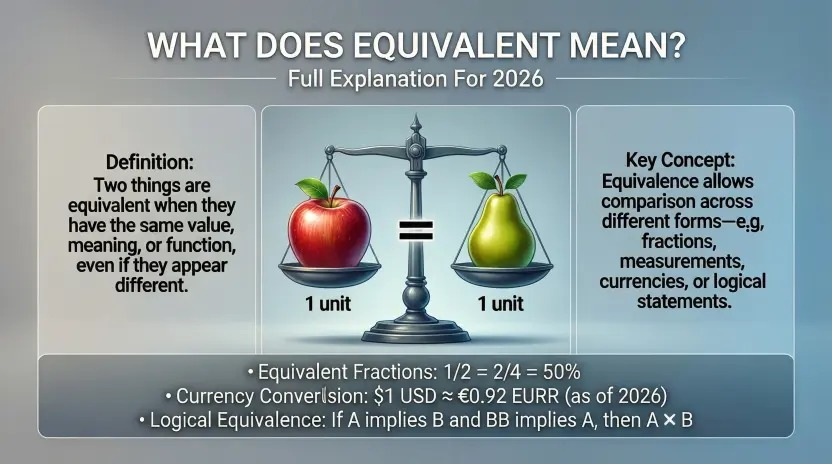
At its core, equivalent refers to something that is equal in value, function, meaning, or effect, even if it isn’t exactly the same in every detail. Understanding this concept can make comparing numbers, objects, ideas, or even words much easier.
In math, fractions like 1/2 and 2/4 are equivalent because they represent the same value. In science, units like liters and milliliters can show equivalence.
Even in daily life, two different phrases can convey equivalent meanings. By grasping what equivalent really means, you’ll not only improve your problem-solving and communication skills but also gain a sharper understanding of the world around you.
In this article, we’ll explore the definition, examples, related terms, and applications of “equivalent” across different contexts.
The Meaning of Equivalent
The word “equivalent” is often used in situations where two or more things are considered equal in value, function, meaning, or effect, even if they are not exactly the same in every detail. Unlike the word “identical,” which implies complete sameness, equivalent focuses on equality in purpose or outcome rather than exact appearance.
For example, in mathematics, two fractions like 1/2 and 2/4 are not identical; they look different but they are equivalent because they represent the same quantity. Similarly, in language, saying “I’m tired” is equivalent in meaning to saying “I need some rest.” Both convey the same idea, even though the words differ.
Equivalence is also important in everyday problem-solving. When comparing products, services, or solutions, you often look for options that are functionally equivalent, meaning they achieve the same result. In finance, two investments may be equivalent if they provide similar returns over the same period.
Understanding the concept of equivalence allows you to compare and assess items, values, or ideas accurately, making your decisions smarter and communication clearer. It bridges gaps between things that are different in appearance but equal in value or effect.
In short, equivalence is about equality of value or function, not exact sameness, and this subtle difference makes it a powerful concept in math, science, language, and daily life.
Related Terms and Concepts
To fully understand the equivalent, it helps to explore some closely related terms. While these words are similar, each has its own nuance and usage.
- Equal – This term indicates exact sameness in quantity or value. For example, 5 + 3 is equal to 8. While equivalent things may be equal in value, they do not always look identical.
- Identical – Something that is completely the same in every detail is identical. For instance, two printed copies of the same document are identical, whereas equivalent documents may convey the same information but be formatted differently.
- Comparable – This refers to items that are similar enough to be compared. While comparable things may not be equal or equivalent, they share characteristics that allow for meaningful comparison.
- Interchangeable – Items that can replace each other without affecting the outcome are interchangeable. For example, two brands of batteries may be interchangeable if they power a device equally well.
- Synonymous – Often used in language, this refers to words that have the same or very similar meaning. For example, “happy” and “joyful” are synonymous. While synonymous words are equivalent in meaning, they may carry slightly different tones.
Understanding these terms helps clarify the unique role of equivalence: it focuses on functional or value equality rather than exact sameness. In other words, equivalent emphasizes the result or purpose, making it applicable in math, science, finance, and daily life.
By knowing these related concepts, you can communicate and reason more precisely, ensuring that your use of “equivalent” is accurate and effective.
Equivalent in Mathematics
In mathematics, the concept of equivalence is used extensively to show that two expressions, numbers, or fractions represent the same value, even if they appear different. Understanding equivalence is essential for solving problems accurately and simplifying calculations.
One of the most common examples is fractions. Take 1/2 and 2/4. They are not identical, they look different but they are equivalent because they represent the same portion of a whole. Similarly, 3/6 and 1/2 are equivalent fractions. Recognizing these relationships makes it easier to add, subtract, or compare fractions.
Equivalence also applies to decimals and percentages. For instance, 0.25 is equivalent to 25%, and 0.5 is equivalent to 1/2. Understanding these equivalencies allows you to switch between formats depending on the problem.
In algebra, two expressions can be equivalent if they have the same value for all possible variable substitutions. For example, x + x + 2 is equivalent to 2x + 2. Though the expressions look different, they produce the same result when evaluated.
Equivalence in mathematics is not just about numbers it also applies to equations and formulas. Recognizing equivalent expressions or equations helps simplify complex problems, solve puzzles efficiently, and verify solutions.
In short, mathematical equivalence is about equal value, not identical appearance. Mastering this concept is crucial for students, professionals, and anyone working with numbers or calculations.
Equivalent in Science
The concept of equivalence plays a vital role in science, particularly in measurements, chemistry, and physics, where it helps scientists compare and convert different quantities accurately. In science, equivalence often refers to different forms or units that represent the same value or effect.
In chemistry, equivalent amounts of substances are used to ensure reactions are balanced. For example, one mole of hydrogen gas reacts with half a mole of oxygen gas to produce water. These amounts are considered chemically equivalent because they produce the same number of molecules necessary for the reaction.
Equivalence also applies to units of measurement. One liter of water is equivalent to 1,000 milliliters, and 1 meter is equivalent to 100 centimeters. Recognizing these equivalents allows scientists, engineers, and students to convert measurements easily without altering the underlying value.
In physics, energy equivalence is commonly used. For instance, calories can be converted to joules: 1 calorie is equivalent to approximately 4.184 joules. This helps compare energy across different systems and ensures consistency in calculations.
Even in biology, equivalent concepts are used to compare doses, volumes, or weights of substances, ensuring experiments are accurate and reproducible.
In short, in science, equivalence emphasizes equality in value or effect, even if the forms or units differ. Mastering this concept allows for precise calculations, meaningful comparisons, and accurate communication in scientific contexts.
Equivalent in Finance and Economics
In finance and economics, the term equivalent is often used to compare monetary value, investments, or financial outcomes. It allows individuals and businesses to assess options that may look different but offer the same value or result.
One common example is currency conversion. For instance, 1 US dollar is approximately equivalent to 110 Japanese yen (depending on the current exchange rate). While the numbers differ, the value is considered equivalent for practical purposes in transactions.
Equivalence is also important in investments. Two different financial products may be considered equivalent if they provide similar returns over the same period. For example, a savings account and a fixed deposit might offer equivalent interest rates, allowing investors to choose based on convenience or risk tolerance rather than returns.
In economic comparisons, equivalent measures help standardize value across regions or time periods. For instance, economists might compare the equivalent purchasing power of a dollar in 2000 versus today to understand inflation and cost-of-living changes.
Even in everyday personal finance, equivalence comes into play. When budgeting, you might consider two different brands of groceries equivalent if they provide the same quality and quantity at similar prices.
In short, in finance and economics, equivalent emphasizes equality in value or outcome rather than appearance, helping people make informed decisions and comparisons in monetary and economic contexts.
Equivalent in Everyday Life
The concept of equivalence is not limited to math, science, or finance; it appears frequently in everyday life, often without us even noticing. Understanding equivalence can make daily decisions, comparisons, and communication much clearer.
For example, in language, two phrases can be equivalent if they convey the same meaning. Saying “I’m tired” is equivalent to “I need some rest.” Both expressions communicate the same idea, even though the words differ. Similarly, “fast food” and “quick meal” can be equivalent depending on context.
Equivalence also applies to household items. If a recipe calls for one cup of sugar, you can use 200 grams instead because these measurements are equivalent. Two brands of batteries may also be equivalent if they provide the same voltage and can power your device equally well.
Even in technology, equivalents appear frequently. A gigabyte of data is equivalent to 1,024 megabytes, and different versions of software may be equivalent in functionality despite minor design differences.
Recognizing equivalence in daily life helps make smart choices and avoid confusion. It allows you to compare items, substitute products, or understand different expressions without changing the intended outcome.
In short, equivalence is about function, value, or meaning, not exact similarity. Once you understand this, you can navigate language, measurements, and decisions more effectively in everyday life.
How to Determine if Two Things are Equivalent
Determining If two things are equivalent requires understanding the criteria that define equality in value, function, or meaning. Equivalence does not necessarily mean the items are identical, it means they serve the same purpose, produce the same result, or represent the same value.
In mathematics, you can check equivalence by simplifying expressions or comparing values. For example, 1/2 is equivalent to 2/4 because both simplify to the same fraction. In algebra, two expressions are equivalent if they produce the same result for all possible variable values, such as x + x + 2 being equivalent to 2x + 2.
In science, equivalence is often determined by conversion or reaction outcomes. One liter of water is equivalent to 1,000 milliliters, and one calorie of energy is equivalent to 4.184 joules. In chemistry, equivalent amounts of reactants are calculated based on their ability to fully participate in a reaction without leftover material.
In language and communication, equivalence is assessed by meaning and context. Two phrases or sentences are equivalent if they convey the same idea, even with different wording. For example, “I’m hungry” is equivalent to “I need to eat.”
In finance, equivalence is measured by value or return. Two investments are equivalent if they provide similar returns, or two currencies are equivalent at a given exchange rate.
Ultimately, determining equivalence involves evaluating value, function, or meaning rather than appearance, ensuring that comparisons are accurate and practical in any context.
Common Mistakes and Misunderstandings
While the term equivalent seems straightforward, it is often misunderstood or misused. One common mistake is confusing equivalents with identical. Two things can be equivalent without being exactly the same. For example, 1/2 and 2/4 are equivalent fractions; they represent the same value but they are not identical in appearance. Similarly, two different brands of batteries may be equivalent in performance but not identical in design.
Another frequent error is interchanging equivalent with equal. Although equivalent items are equal in value, function, or effect, they are not always exactly equal in quantity or form. For instance, 0.25 is equivalent to 25%, but the two are expressed differently.
In language, people sometimes assume that two words or phrases are equivalent simply because they sound similar. However, subtle differences in tone or context can make them non-equivalent. For example, “happy” and “content” are similar but not entirely equivalent in emotional intensity.
In finance, assuming that two investments are equivalent based only on their price is another mistake. Equivalence should consider returns, risk, and time period rather than just cost.
Lastly, many overlook context, which is crucial for determining equivalence. What is equivalent in one situation may not be in another. For example, 1 cup of sugar is equivalent to 200 grams in baking, but the same substitution might not work in another recipe requiring exact volume.
Understanding these common mistakes ensures you use the term equivalent accurately, improving clarity in math, science, finance, and everyday communication.
Fun Facts and Interesting Uses
The concept of equivalence is not only practical, it can also be fun and surprising when you notice it in everyday life and pop culture. Understanding equivalence can give you a new perspective on how things relate, compare, and even entertain.
For example, in gaming, different power-ups or items can be equivalent in effect. Two different weapons in a video game might deal the same damage, making them equivalent choices for a player, even if their appearances or special abilities differ.
In food and cooking, equivalence appears in substitutions. One egg can be equivalent to a quarter cup of applesauce in baking, or one teaspoon of lemon juice might be equivalent to a small splash of vinegar to achieve a similar flavor reaction. Knowing these equivalents allows for creativity in the kitchen.
Even in language and humor, equivalents show up frequently. Synonyms and idioms often convey the same meaning in different words. For instance, “break a leg” and “good luck” are equivalent expressions in theater, even though one is figurative.
In science trivia, fun equivalents exist too. One kilowatt-hour of energy is equivalent to roughly 3.6 million joules. Or, in space exploration, the weight of 1 liter of water on Earth is equivalent to about 0.38 liters on Mars due to gravity differences.
These examples show that equivalence is everywhere, from practical problem-solving to playful comparisons. Spotting equivalents can make learning, cooking, gaming, or even conversation more interesting and insightful.
FAQs about Equivalent
People often have questions about the term equivalent, especially when it appears in math, science, or everyday life. Here are some of the most common FAQs with clear answers.
Q1: What is the difference between equivalent and equal?
Equivalent refers to items that have the same value, function, or meaning, even if they are not identical in appearance. Equal usually implies exact sameness in quantity or number. For example, 1/2 and 2/4 are equivalent, but not exactly equal in form.
Q2: Can equivalent things be different?
Yes. Equivalent things can look or appear different but serve the same purpose or have the same effect. In language, two phrases can convey the same meaning, while in science, different units can represent the same value.
Q3: How is the equivalent used in math?
In math, equivalent is used to compare fractions, decimals, percentages, and algebraic expressions. Two expressions are equivalent if they produce the same result for all values of their variables.
Q4: What does equivalent mean in finance?
In finance, equivalent is used to compare monetary value, returns, or investments. Two financial products can be equivalent if they provide similar benefits, even if they are structured differently.
Q5: How can I determine if two things are equivalent?
Check for equality in value, function, or meaning rather than appearance. Use calculations in math, unit conversions in science, or contextual understanding in language.
These FAQs help clarify common confusions and show how equivalent applies across different fields, making it a versatile and important concept to understand.
Conclusion
Understanding the term equivalent is more than just knowing a dictionary definition; it’s about recognizing equality in value, function, or meaning across different contexts.
From mathematics and science to finance, language, and everyday life, the concept of equivalence helps us compare, convert, and communicate effectively.
In math, equivalence allows us to simplify fractions, convert decimals to percentages, and check algebraic expressions.
science, it ensures accuracy in measurements, chemical reactions, and energy calculations.
finance, equivalence helps compare investments, currencies, and economic values. Even in daily life, recognizing equivalent phrases, measurements, or items helps us make better decisions and understand the world more clearly.
Equivalence is not the same as identity or exact sameness. Two things can look different yet be equivalent in value or purpose. Recognizing this subtle difference improves problem-solving skills, decision-making, and communication.
By understanding the concept of equivalence, you gain a tool that is versatile and practical. It enables you to navigate numbers, words, units, and real-world choices with confidence.
If you are a student, professional, or simply curious about language and logic, grasping what it means to be equivalent makes learning and reasoning much easier.
In short, equivalent is all about equal effect, value, or meaning, bridging the gap between things that may appear different but are functionally or conceptually the same. Master this concept, and you’ll see the world with sharper clarity and understanding.

Punny Parker — Serving witty wordplay, clever jokes, and daily pun-filled fun. Whether it’s smart humor or pure silliness, every post brings a smile, a laugh, or a groan-worthy pun you’ll secretly love. Powered by ThePunSide.com for endless laughs and wordplay magic every day.