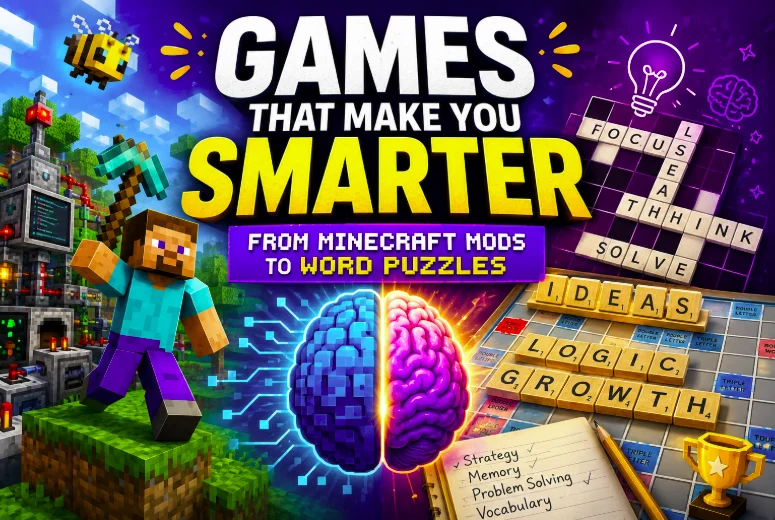
Not all games are created equal when it comes to what they do to your brain. Some numb. Some distract. And some — the ones worth talking about — genuinely develop cognitive skills that show up outside the game. Here’s the science behind why certain games make you smarter, and two of the best free examples available right now.
The Myth of the Wasted Hour
For as long as games have existed, the dominant cultural narrative about playing them has been one of waste. Time spent gaming is time not spent doing something productive. The brain, supposedly, switches off. Entertainment happens. Nothing of value is generated.
This narrative is wrong — not slightly wrong, not nuanced-wrong, but flatly contradicted by decades of cognitive science research. The question is not whether games can develop genuine cognitive skills. The evidence that many of them do is robust and well-established. The question is which games, what skills, and under what conditions.
The answer depends almost entirely on what a game asks of its players. Games that require active problem-solving, spatial reasoning, pattern recognition, vocabulary retrieval, and hypothesis formation develop the cognitive systems engaged in those tasks. Games that require only reflexes, or no active engagement at all, develop only those things.
This article is about two games that ask a great deal of their players — and deliver cognitive returns that show up clearly both inside and outside the game.
What Makes a Game Cognitively Valuable
Before examining the games themselves, it helps to understand what cognitive science tells us about the conditions under which games produce genuine learning.
Active engagement over passive consumption. The single most important variable is whether the player is actively engaging — forming hypotheses, making decisions, receiving feedback, and updating their mental model — or passively consuming. Games that require active engagement consistently outperform passive entertainment on every cognitive outcome measured.
Desirable difficulty. Cognitive psychologist Robert Bjork’s research on learning conditions consistently demonstrates that the most durable skill development occurs under conditions of appropriate challenge — tasks that are hard enough to require genuine effort but achievable enough to produce success. Games that calibrate this balance produce deeper cognitive development than games that are either trivially easy or frustratingly hard.
Immediate, accurate feedback. The brain connects cause and effect most powerfully when the gap between action and consequence is shortest. Games that provide instant, accurate feedback on every decision — you built the structure and it worked, or it didn’t; you found the word or you didn’t — create tight learning loops that accelerate skill development dramatically.
Transfer to real-world skills. The most valuable games develop skills that are not unique to the game context but transfer to real-world tasks. Spatial reasoning developed in a building game transfers to engineering and design problems. Vocabulary developed through a word puzzle transfers to reading, writing, and communication.
Two games meet all four of these criteria — one of them a Minecraft mod, one of them a word puzzle companion. Here is what each one does to your brain.
Minecraft as a Cognitive Development Tool
Why Minecraft Is Already Educational
Before discussing what Minecraft adds, it is worth establishing why Minecraft itself is one of the most cognitively rich game environments ever created.
Minecraft is fundamentally a spatial problem-solving game. Building anything — from a simple shelter to a complex redstone mechanism — requires the player to hold a three-dimensional spatial plan in working memory, decompose it into sequential steps, execute those steps while tracking resources and constraints, and adapt when the outcome diverges from the plan. These are not simple cognitive tasks. They are the same tasks required by architecture, engineering, programming, and any other domain that requires translating an abstract intention into a concrete physical structure.
The research on Minecraft as an educational tool is extensive. Studies have documented improvements in spatial reasoning, collaborative problem-solving, sequential planning, and creative ideation among regular players. The game has been adopted by educators in dozens of countries specifically because its cognitive demands map onto real-world skills in ways that most games do not.
What Jenny Mod Adds
Jenny Mod extends the cognitive richness of Minecraft by adding new mechanics, characters, and interactions that require players to adapt existing strategies and develop new ones. The effect of a well-designed mod on an experienced Minecraft player is to recreate the cognitive conditions of early learning — the period when everything is new, strategies haven’t been automated, and every decision requires genuine active engagement rather than habitual execution.
This matters cognitively because automaticity — the process by which skills become habitual and stop requiring conscious attention — reduces the cognitive development that comes from active engagement. An experienced Minecraft player navigating familiar terrain is exercising less cognitive development than a new player encountering the same terrain for the first time.
It disrupts this automaticity. It reintroduces novelty into a familiar environment, forcing the brain to re-engage actively with systems and decisions it had previously automated. This is one of the most efficient ways to continue developing cognitive skills from a game you’ve already played extensively — and it does so without requiring a completely new game or a completely new learning curve.
Specific cognitive skills developed:
Adaptive planning. The mod introduces new variables that require existing plans to be modified in real time. This adaptive planning — holding a goal stable while flexibly updating the means of achieving it — is one of the most valuable executive function skills, associated with success in complex professional environments.
Novel problem decomposition. New mechanics require new approaches to decomposing complex goals into achievable steps. The cognitive skill of breaking a novel problem into manageable components, developed through repeated practice in the game, transfers directly to professional and academic problem-solving.
Spatial creativity. New building possibilities introduced by the mod expand the player’s spatial creative repertoire — the range of spatial solutions they can imagine and execute. Spatial creativity is a foundational skill for design, engineering, architecture, and any domain that requires visualising solutions in three dimensions.
Puzzle Solver — Vocabulary Development Through the World’s Best Daily Puzzle
The NYT Spelling Bee as a Cognitive Tool
The New York Times Spelling Bee has become one of the most widely played daily word puzzles on the internet — and its popularity is not accidental. The puzzle’s design creates near-optimal conditions for vocabulary development through a mechanism that most people engage with intuitively without understanding the cognitive science behind it.
Seven letters. One required center letter. The challenge of finding every valid English word they contain. The pangram — the word using all seven letters — as the daily ultimate challenge.
The difficulty is real and deliberate. The Spelling Bee regularly surfaces valid English words that educated native speakers have never consciously encountered. Words that live in the serious but accessible corners of the lexicon where literary vocabulary meets technical vocabulary. Finding all of them requires active, systematic exploration of one’s own lexical memory — a genuine cognitive workout rather than a passive vocabulary review.
What Spelling Bee Solver Adds
Spelling Bee Solver transforms the Spelling Bee from an enjoyable daily puzzle into a systematic vocabulary acquisition practice — and the cognitive mechanism it activates is one of the most powerful in the research literature.
The practice is straightforward: play the Spelling Bee completely independently, pushing your vocabulary to exhaustion against those seven letters, then open the solver and see every valid word the combination contained.
The gap between what you found and what the solver reveals is where the learning happens.
The generation effect. Cognitive psychologist Endel Tulving’s research on memory encoding demonstrated that information encountered after a failed retrieval attempt is retained significantly more strongly than information encountered without prior attempt. The neural mechanism involves the hippocampus, which tags information as higher priority for encoding when it arrives in the context of a prediction error — the gap between what you searched for and what you found.
Every word in the solver’s output that you didn’t find represents exactly this condition. You searched for it, failed, and now encounter it. Your brain is primed to encode it more strongly than it would encode any word on a vocabulary list you hadn’t tried to recall first. The solver exploits this mechanism automatically, for every missed word, every single day.
Morphological pattern recognition. Regular Spelling Bee play combined with solver review builds an intuitive sense of English morphology — the patterns by which the language forms words, the prefixes and suffixes that multiply across the lexicon, the letter combinations that English favours in different word positions. This morphological intuition develops below conscious awareness and shows up as a genuine improvement in reading fluency and writing precision.
Active lexical retrieval practice. The act of searching your lexical memory for valid words — systematically, actively, under mild time pressure — exercises the retrieval pathways that connect stored vocabulary to active use. Regular retrieval practice strengthens these pathways in exactly the same way that physical exercise strengthens the muscles involved. Vocabulary that was stored but rarely retrieved becomes more readily accessible.
Spaced repetition through natural recurrence. Words that appear in one Spelling Bee combination recur in similar combinations over subsequent weeks. A word learned through the solver in one session will reappear as a retrieval opportunity in a future session — initially requiring conscious effort, eventually becoming automatic. This natural spaced retrieval schedule mirrors the optimal spacing intervals identified by memory researchers without requiring any deliberate scheduling.
The Cognitive Skills That Transfer
The vocabulary and language skills developed through regular Spelling Bee and solver practice transfer to real-world performance in ways that are measurable and meaningful.
Reading comprehension. A richer active vocabulary reduces the cognitive load imposed by unfamiliar words during reading — freeing attentional resources for comprehension and synthesis rather than decoding. Regular players consistently report that dense academic, legal, and literary texts feel less effortful over time.
Writing precision. The most immediate professional benefit of expanded active vocabulary is precision in writing — the ability to find the exact word rather than the closest available approximation. This precision is the difference between writing that merely conveys information and writing that conveys it with authority.
Communication fluency. Reduced tip-of-the-tongue experiences, faster word retrieval in conversation, and a broader range of available expression all contribute to communication that feels more confident and more credible to listeners and readers.
The Combined Cognitive Stack
Used together — Minecraft providing the long-form spatial and creative cognitive workout, and the puzzle solver providing the daily vocabulary and language development practice — these two tools form a cognitive development stack that covers complementary skill sets.
Spatial reasoning, adaptive planning, and creative problem-solving from the Minecraft mod. Vocabulary depth, lexical fluency, and morphological pattern recognition from the word puzzle and solver. Between them, they cover cognitive ground that formal education rarely develops as systematically or as enjoyably.
The investment is modest. An evening of Minecraft several times a week. Fifteen minutes with the Spelling Bee and solver each morning. The skills that compound from this investment show up in professional performance, academic outcomes, and the quality of everyday thinking in ways that are difficult to attribute to a game — but that the research suggests are causally connected to exactly this kind of deliberate, engaged play.
The best games have always done this. Made you better at something without ever feeling like work.
These are two of the best current examples of a tradition as old as games themselves.
What games have made you measurably smarter? Share your experience in the comments — and if there’s a free browser game or mod that belongs in this conversation, drop it below.