Scrolling through Reddit, Discord, or your favorite group chat, you might have come across the mysterious acronym IIRC and wondered, “What does that even mean?”
If so, you’re not alone. Internet slang is constantly evolving, and acronyms like IIRC can leave even seasoned online users scratching their heads.
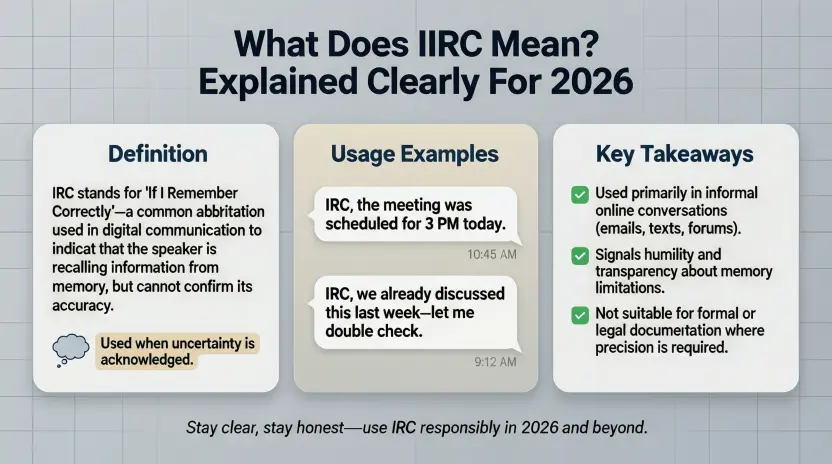
IIRC stands for “If I Recall Correctly” or “If I Remember Correctly” and is commonly used to indicate that the information being shared might not be 100% certain.
It’s a polite way to express memory-based statements without sounding authoritative or rigid.
In this article, we’ll dive deep into the meaning of IIRC, its origin, proper usage in texting, forums, and social media, common mistakes to avoid, and alternatives you can use.
By the end, you’ll confidently understand IIRC and know exactly how and when to use it online.
What Does IIRC Mean?
IIRC is an acronym that stands for “If I Recall Correctly” or sometimes “If I Remember Correctly.” It is widely used in online chats, social media, forums, and messaging apps to indicate that the information being shared is based on memory and may not be completely accurate. Using IIRC shows that you’re providing information to the best of your knowledge without claiming absolute certainty.
For example, in a conversation about a movie release, you might say:
- “IIRC, the sequel comes out next summer.”
Here, IIRC signals that you are fairly sure of the release date, but there’s a chance you might be mistaken. This makes conversations polite and casual while preventing misunderstandings.
IIRC is most commonly used in informal communication, including platforms like Reddit, Discord, WhatsApp, or gaming chats. It allows users to contribute to discussions while acknowledging the limits of their memory. Unlike formal writing, where precision is key, IIRC adds a conversational tone and helps maintain friendly communication online.
In short, whenever you want to share information but hint that you might not remember it perfectly, IIRC is the ideal acronym. It’s a small but powerful tool in the world of internet slang, helping you communicate clearly and politely.
Origin of IIRC
The acronym IIRC has its roots in the early days of online communication, particularly in Internet Relay Chat (IRC), which was one of the first platforms where people could chat in real-time over the internet. Users needed a fast, efficient way to communicate, and typing out full phrases like “If I Recall Correctly” was too slow during fast-paced conversations. That’s how IIRC became popular as a concise, easy-to-type abbreviation.
Over time, IIRC spread beyond IRC into other online communities, including forums, gaming chats, Reddit threads, and Discord servers. By the late 2000s, it had become a widely recognized acronym among internet-savvy users. Its main purpose has always been to indicate uncertainty or memory-based statements without sounding rude or overly formal.
The evolution of IIRC reflects the general trend of internet slang, where efficiency, brevity, and tone are all important. Just like other abbreviations such as AFAIK (“As Far As I Know”) or IMO (“In My Opinion”), IIRC helps people communicate clearly and politely in informal online settings.
Today, IIRC is still widely used across texting apps, social media, and professional online communities where casual conversation is acceptable. Knowing the origin of IIRC not only helps you understand its meaning but also provides context for when and why it’s appropriate to use in your own messages.
How to Use IIRC in Sentences
Using IIRC correctly can make your online communication more clear and polite. This acronym is typically used when you want to share information from memory but aren’t entirely sure it’s 100% accurate. Placing IIRC at the beginning or middle of a sentence is common, depending on how formal or casual your message is.
Examples for casual chats:
- “IIRC, the meeting starts at 3 PM, but double-check the calendar.”
- “IIRC, this game got a new update last week.”
In these examples, IIRC signals that you’re reasonably confident, but there’s a small chance your memory might be off. It prevents misunderstandings and keeps conversations polite.
Examples for forums or social media:
- “IIRC, the book was first published in 2015, not 2016.”
- “IIRC, she mentioned the event would be held online this year.”
Here, IIRC helps maintain a friendly and conversational tone, which is especially useful on platforms like Reddit or Discord, where users often discuss facts or opinions casually.
Tips for proper usage:
- Always place a comma after IIRC if it’s at the start of a sentence.
- Use it only when the information is memory-based, not when giving verified facts.
- Avoid overusing IIRC in a single conversation, as it can make your statements seem uncertain or repetitive.
By using IIRC correctly, you can communicate clearly, politely, and efficiently, making your online interactions smoother and more natural.
IIRC vs Similar Acronyms
In the world of internet slang, acronyms like IIRC are often confused with others, but each has a slightly different meaning and use. Understanding these differences will help you communicate more clearly and avoid misunderstandings.
IIRC stands for “If I Recall Correctly” or “If I Remember Correctly”. It is used to indicate that the information you are sharing is from memory and might not be 100% accurate. It is polite, casual, and conveys uncertainty.
Other common acronyms include:
- AFAIK – “As Far As I Know”: Used when you are providing information based on what you know, but you may not have the full details. Example: “AFAIK, the event starts at 5 PM.”
- FYI – “For Your Information”: Used to share information that someone might find useful, without implying uncertainty. Example: “FYI, the report was submitted yesterday.”
- IMO / IMHO – “In My Opinion / In My Humble Opinion”: Used to express personal opinions rather than factual information. Example: “IMO, this is the best strategy for the game.”
Key Difference: While AFAIK expresses knowledge with some uncertainty, IIRC specifically signals that you are relying on memory. FYI is purely informational, and IMO/IMHO conveys opinion rather than memory-based facts.
By understanding these subtle distinctions, you can choose the right acronym for the right context, making your messages clear, polite, and appropriate for online chats, forums, or social media. Misusing these acronyms can confuse readers or make your statements appear less credible.
Why People Use IIRC
People use IIRC in online conversations for several practical and social reasons. At its core, IIRC signals that the information being shared is memory-based and might not be entirely accurate. This small acronym helps maintain clarity, politeness, and casual tone in digital communication.
One major reason for using IIRC is to avoid sounding overly confident or authoritative. For example, instead of stating, “The game update was last Thursday,” saying, “IIRC, the game update was last Thursday” makes the statement softer and more conversational. It shows that you are contributing information without insisting it is 100% correct.
IIRC is also popular because it saves time. Typing out “If I Recall Correctly” can be cumbersome in fast-paced chats on Discord, Reddit, or WhatsApp, whereas the three-letter acronym gets the point across instantly.
Another reason people use IIRC is to signal awareness of uncertainty. In online discussions, users often exchange facts, news, or personal recollections. Using IIRC demonstrates humility and thoughtfulness, acknowledging that memory can be imperfect.
Finally, IIRC helps maintain a friendly and casual tone in digital conversations. Unlike formal writing, online communication often values efficiency, brevity, and politeness. By using IIRC, you participate in the flow of conversation without sounding rigid or overly formal.
In short, IIRC is more than just an acronym; it’s a communication tool that balances accuracy, courtesy, and casual style in online interactions.
Common Mistakes with IIRC
While IIRC is a simple and useful acronym, many people make mistakes when using it. These errors can lead to confusion or make your messages appear careless. Understanding these common pitfalls will help you use IIRC correctly and confidently.
1. Using IIRC in Formal Writing:
One of the most frequent mistakes is including IIRC in professional emails, reports, or academic papers. IIRC is informal and casual, so using it in formal contexts can appear unprofessional. For example, writing “IIRC, the meeting is at 10 AM” in an official email is inappropriate; instead, use “To the best of my knowledge, the meeting is at 10 AM.”
2. Confusing IIRC with Similar Acronyms:
Some people mix up IIRC with acronyms like AFAIK (“As Far As I Know”) or IMO (“In My Opinion”). Remember: IIRC specifically relates to memory, whereas AFAIK is about knowledge and IMO is about opinions. Misusing these can change the meaning of your sentence.
3. Overusing IIRC:
Using IIRC in every sentence can make your statements seem uncertain or hesitant. For example: “IIRC, the event is tomorrow. IIRC, it starts at 5 PM. IIRC, it’s online.” Overuse diminishes clarity and readability.
4. Incorrect Placement in Sentences:
Placing IIRC in awkward spots or forgetting punctuation (like a comma) can make sentences confusing. Correct usage: “IIRC, the movie was released last year.”
By avoiding these mistakes, you can use IIRC naturally, clearly, and politely, making your online conversations smoother and more credible.
Is IIRC Formal or Informal?
Understanding the tone of IIRC is essential for using it appropriately. The acronym is strictly informal and is designed for casual communication. It is widely used in texting, social media, forums, and online gaming, but it is not suitable for formal emails, academic writing, or professional reports.
The informal nature of IIRC comes from its origin in internet chatrooms and early messaging platforms. Users needed a short, efficient way to convey memory-based statements, and IIRC fit that purpose perfectly. Unlike formal phrasing such as “To the best of my knowledge” or “If my memory serves me correctly,” IIRC adds a friendly, conversational tone.
Examples of informal use:
- Chatting with friends: “IIRC, the concert starts at 8 PM.”
- On Reddit: “IIRC, this game update fixed the bug you mentioned.”
- Discord or gaming chats: “IIRC, the boss respawns every 10 minutes.”
Examples of inappropriate formal use:
- Business email: “IIRC, the meeting is scheduled for Monday.” ✅ Not suitable. Use: “According to my notes, the meeting is scheduled for Monday.”
- Academic paper: “IIRC, this theory was proposed in 1990.” ✅ Too casual. Use: “According to Smith (1990), this theory was proposed…”
In short, IIRC is casual, friendly, and perfect for online conversations but should be avoided in professional or formal contexts. Using it in the right environment ensures your communication is clear, appropriate, and well-received.
IIRC in Texting, Gaming, and Social Media
IIRC has become a staple in casual online communication, and its usage varies slightly depending on the platform. Whether you’re texting a friend, chatting in a gaming community, or posting on social media, understanding these contexts will help you use IIRC effectively.
1. Texting and Messaging Apps:
In apps like WhatsApp, iMessage, or Telegram, IIRC is often used to clarify memory-based statements in quick conversations. For example:
- “IIRC, the party starts at 7 PM. Are you coming?”
It keeps your message short and polite while signaling that your information may not be perfect.
2. Gaming Chats:
Gamers often use IIRC in fast-paced chats on Discord or in-game chat to recall strategies, spawn times, or game updates. Example:
- “IIRC, the boss respawns every 10 minutes, so let’s be ready.”
Here, IIRC helps convey memory-based facts without disrupting the flow of conversation.
3. Social Media:
On platforms like Reddit, Twitter, or Facebook, IIRC is frequently used in discussions where users share recollections or trivia. Example:
- “IIRC, this feature was added in the last update, correct?”
It adds a conversational tone and shows humility, acknowledging that memory may not be perfect.
Tips for Using IIRC Across Platforms:
- Place a comma after IIRC when it starts a sentence.
- Avoid overusing it; one or two mentions per conversation are sufficient.
- Use it to show polite uncertainty, not when sharing confirmed facts.
By tailoring your use of IIRC to each platform, you can communicate efficiently, casually, and respectfully, keeping online interactions smooth and friendly.
Alternatives to IIRC
While IIRC is widely used, there are several alternatives you can use to convey memory-based or uncertain information. These alternatives are helpful if you want to vary your language, clarify meaning, or use slightly different tones depending on the context.
1. “If my memory serves me right”
This is a full, formal phrase that can replace IIRC in more professional or semi-formal settings. Example:
- “If my memory serves me right, the meeting is scheduled for 3 PM.”
2. “To the best of my knowledge”
This phrase is useful when you want to communicate uncertainty in a more factual or formal tone. Example:
- “To the best of my knowledge, the software update was released last week.”
3. Similar Acronyms:
- AFAIK – “As Far As I Know”: Indicates partial knowledge rather than memory-based recall.
- IMHO / IMO – “In My Humble Opinion / In My Opinion”: Focuses on personal opinions rather than memory accuracy.
4. Emoji-based equivalents (informal chats):
In casual texting or social media, some people use emojis like 🤔 to indicate uncertainty or memory recall, which can function similarly to IIRC. Example:
- “The event starts at 5 PM 🤔”
Tips for Choosing Alternatives:
- Use IIRC for casual, friendly conversations.
- Choose formal phrases like “If my memory serves me right” in professional or academic settings.
- Use AFAIK when you are confident in your knowledge but still want to signal slight uncertainty.
By knowing alternatives to IIRC, you can adapt your tone and style to different situations while maintaining clarity and politeness.
FAQs
Many people have questions about IIRC, especially regarding its meaning, proper usage, and context. This FAQ section answers the most common queries to help you use IIRC confidently.
1. What does IIRC stand for?
IIRC stands for “If I Recall Correctly” or “If I Remember Correctly.” It’s used to indicate that information is based on memory and may not be completely accurate.
2. Is IIRC rude?
No, IIRC is polite and neutral. It signals uncertainty without sounding dismissive, rude, or overly authoritative. Using it shows thoughtfulness in conversations.
3. Can I use IIRC in professional emails?
It’s best to avoid IIRC in formal writing. Instead, use phrases like “To the best of my knowledge” or “If my memory serves me right.” IIRC is informal and intended for casual online conversations.
4. What is the difference between IIRC and AFAIK?
While IIRC refers specifically to memory-based statements, AFAIK (“As Far As I Know”) signals information you believe to be true, even if you’re not fully certain. IIRC is about recall, AFAIK is about knowledge.
5. Where is IIRC commonly used?
IIRC is widely used in texting, social media platforms like Reddit and Twitter, gaming chats, and Discord servers. It’s suitable for casual online conversations but not formal contexts.
6. Can IIRC be replaced with other phrases?
Yes, alternatives include “If my memory serves me right,” “To the best of my knowledge,” or even emojis like 🤔 in casual chats.
Understanding these FAQs ensures you use IIRC correctly, naturally, and appropriately in all informal online settings.
Conclusion
In today’s fast-paced online world, acronyms like IIRC have become essential tools for clear, concise, and polite communication.
IIRC, which stands for “If I Recall Correctly” or “If I Remember Correctly,” allows users to share information from memory while signaling that it may not be 100% accurate.
This small three-letter acronym can make conversations smoother, more friendly, and less authoritative.
We explored the origin of IIRC, tracing it back to early chat platforms like Internet Relay Chat (IRC), where brevity was crucial.
We also covered how to use IIRC in sentences, platform-specific usage in texting, social media, and gaming, and compared it with similar acronyms like AFAIK and IMO.
Knowing these distinctions ensures that you communicate correctly and avoid misunderstandings.
Additionally, we discussed common mistakes, such as using IIRC in formal writing or overusing it in conversations, and explored alternatives like “If my memory serves me right” or “To the best of my knowledge” for different contexts.
Our FAQ section clarified common doubts about tone, etiquette, and platform suitability.
In short, IIRC is more than just an acronym; it’s a versatile communication tool that balances accuracy, politeness, and casual style.
By understanding its meaning, proper usage, and alternatives, you can confidently use IIRC in online chats, social media, forums, and gaming conversations, making your messages clearer, friendlier, and more effective.