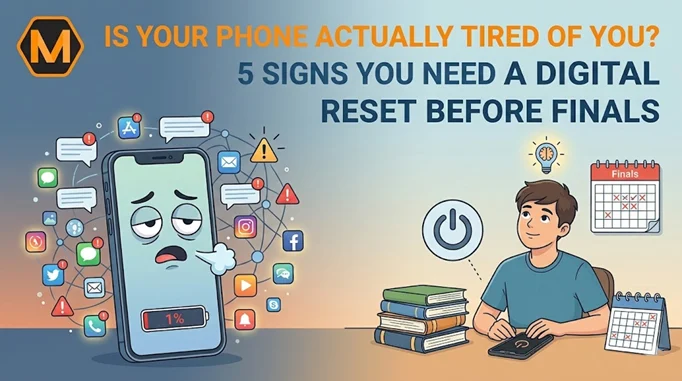
The year 2026 has brought us unparalleled connectivity, but it has also ushered in an era of “digital exhaustion.” Your smartphone is a marvel of engineering, a portal to all human knowledge, and a constant companion. However, the psychological price of being “always on” is beginning to manifest in ways that are hard to ignore. We often talk about our batteries dying, but we rarely discuss how our own internal batteries are being drained by the very devices designed to make our lives easier. For college students, this drain is even more pronounced. You are expected to navigate complex online learning portals, coordinate group projects via instant messaging, and maintain a social presence, all while preparing for the most rigorous academic period of the year: finals week.
The relationship we have with our tech is often parasitic rather than symbiotic. We give it our time, our data, and our undivided attention, and in return, we receive a constant stream of cortisol-spiking notifications. If you feel like your brain is “foggy” or that your ability to concentrate on a single page of text has vanished, you are not alone. This is a systemic issue caused by the high-frequency interaction with digital interfaces. When the mental clutter becomes too loud, students often look for external support to balance the scales. For instance, if you are struggling with a complex subject, finding a qualified economics essay writer at myassignmenthelp can provide the necessary breathing room to step away from the screen and begin a much-needed digital detox without sacrificing your GPA.
The Architecture of Digital Exhaustion
Before diving into the signs of burnout, it is helpful to understand how our focus is partitioned. Our brains have a limited “bandwidth” for processing information. When we are constantly switching between apps, we are essentially “leaking” cognitive energy.
| Digital Habit | Impact on Focus | Long-term Academic Risk |
| Multitasking | Reduces “Deep Work” capability | Lower quality of research and synthesis |
| Blue Light Exposure | Disrupts circadian rhythms | Chronic fatigue and decreased memory retention |
| Infinite Scrolling | Constant dopamine spikes | Decreased patience for long-form reading |
| Push Notifications | Fragmented attention span | Inability to enter “Flow State” during exams |
1. The “Phantom Vibration” Syndrome
Have you ever reached for your phone because you “felt” it buzz in your pocket, only to realize the screen is dark and no notification exists? This is a documented psychological phenomenon known as Phantom Vibration Syndrome (PVS). It occurs when your cerebral cortex misinterprets sensory input—like the friction of your clothes—as a signal from your device.
In a high-stress environment like finals week, your brain is in a state of hyper-vigilance. You are so worried about missing an important email or a peer’s message that your nervous system stays on high alert. This constant state of “readiness” prevents you from ever truly relaxing. If you are experiencing PVS more than once a day, it is a clear sign that your brain has become pathologically tethered to your hardware. A digital reset is required to “re-calibrate” your sensory perceptions and lower your baseline anxiety levels.
2. The “Goldfish” Attention Span
In 2026, the average attention span for digital content has dropped significantly. We are conditioned to consume information in 15-second bursts. While this might be fine for entertainment, it is disastrous for academic success. College-level work requires “Deep Work”—the ability to focus without distraction on a cognitively demanding task for several hours.
If you find yourself opening a new tab every five minutes while trying to research a paper, your focus has been fragmented. This fragmentation makes it nearly impossible to grasp complex theories or follow a logical argument from beginning to end. When your phone has “tired you out,” you lose the intellectual stamina required to succeed. You might find yourself staring at a blank document for an hour, only to realize you spent forty minutes of that time looking at memes. This is the moment to realize that your digital habits are actively sabotaging your career goals.
3. The 3 AM Doom-Scroll Cycle
Sleep is the most effective cognitive enhancer available to humans. During sleep, the brain flushes out toxins and consolidates memories—essentially moving what you learned during the day into long-term storage. However, the “3 AM Doom-Scroll” has become a rite of passage for the modern student.
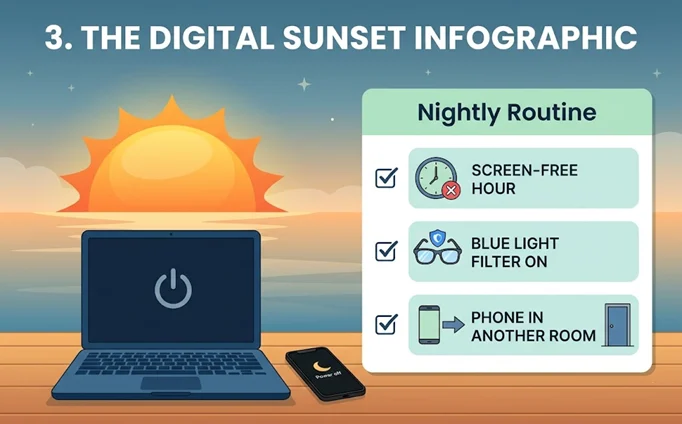
This behavior is often a form of “revenge bedtime procrastination.” Because students feel they have no control over their busy daytime schedules, they stay up late to reclaim a sense of freedom through entertainment. Unfortunately, the blue light emitted by screens suppresses melatonin, making the sleep you do eventually get much less restorative. A digital reset helps you establish a “digital sunset”—a time when all devices are powered down to allow the brain to enter its natural recovery phase. Without this, you are walking into your finals with a brain that is functionally impaired by sleep deprivation.
4. Physical “Tech-Fatigue” and Eye Strain
The signs of being overwhelmed by tech aren’t just invisible mental hurdles; they are physical realities. “Tech-Neck” is a real condition caused by the strain of looking down at a mobile device for hours on end, which puts up to 60 pounds of extra weight on the cervical spine. Furthermore, Computer Vision Syndrome (CVS) leads to dry eyes, blurred vision, and frequent tension headaches.
When you reach this level of physical discomfort, your body is telling you that the digital world is taking a physical toll. This is often the point where students realize they cannot do it all alone. Accessing professional Essay Help is a strategic way to manage these physical demands. By delegating a particularly grueling draft or research task, you can step away from the blue light, stretch your muscles, and allow your eyes to recover before the big exam day.
5. Emotional Volatility and “App-Anxiety”
Does your mood change based on how many people engaged with your latest post? Or do you feel a sense of dread when you see a “red bubble” notification on a specific app? This is “App-Anxiety.” When our emotional well-being is tied to digital metrics, we lose our internal stability.
During finals, your emotional energy should be reserved for resilience and perseverance. If you are spending that energy worrying about your digital “stats” or comparing your life to the “perfect” study aesthetics of influencers, you are draining your tank. A digital reset involves deleting the apps that cause the most stress and reconnecting with the real-world environment around you.
The 48-Hour Reset Protocol: A Student Guide
If you recognize these signs, it’s time for a proactive intervention. You don’t need a month-long retreat; a strategic 48-hour reset can yield massive results.
| Hour Range | Action Item | Goal |
| 0 – 4 Hours | Turn off all non-human notifications. | Stop the “interruption” cycle. |
| 4 – 12 Hours | Establish a “Phone Hotel” (a charging station outside the bedroom). | Reclaim your sleep environment. |
| 12 – 24 Hours | Engage in 1 hour of “Analog” activity (reading a physical book, hiking). | Re-engage the senses. |
| 24 – 48 Hours | Categorize apps: “Utility” vs. “Time-Sink.” Delete 3 time-sinks. | Permanent habit change. |
Moving Toward Proactive Academic Success
A digital reset is not about being “anti-technology.” It is about being “pro-human.” In 2026, the most successful students are those who can command their attention rather than those who are at the mercy of their notifications. By reclaiming your focus, you are giving yourself the best possible chance to excel in your finals.
When you sit down to write that final thesis or study for a complex economics exam, you will notice the difference immediately. Your thoughts will feel clearer, your writing will be more fluid, and your ability to solve problems will be sharper. Technology should be the wind at your back, helping you move forward, not a weight in your backpack slowing you down.
Taking control of your digital life is an act of self-respect. It acknowledges that your goals—getting that degree, launching that career, and maintaining your mental health—are more important than the infinite scroll of a social media feed. As you move into the final weeks of the semester, remember that the most powerful tool you have is not your phone; it is your focused, rested, and determined mind. Choose to protect it.
Frequently Asked Questions
What are the most common signs of digital burnout?
Key indicators include physical strain like “tech-neck,” disrupted sleep patterns, and the sensation of “phantom vibrations.” You may also notice a significant decline in your ability to concentrate on a single task for more than a few minutes without reaching for a device.
How does constant screen time affect academic performance?
Excessive device use fragments your attention, making it difficult to engage in “deep work.” This leads to slower reading comprehension, reduced memory retention, and increased stress levels, all of which can hinder your effectiveness during exam preparation and research.
What is a “digital reset” and how does it help?
A digital reset is a planned break from non-essential technology to allow your nervous system to recover. By setting boundaries with your devices, you reduce cognitive overload, lower anxiety, and help your brain regain the focus necessary for complex problem-solving.
Can a digital detox improve my sleep quality?
Yes. Reducing exposure to blue light, especially in the evening, allows your body to produce melatonin naturally. Establishing a “digital sunset” helps you fall asleep faster and ensures your rest is deep enough to consolidate the information you learned during the day.
About the Author
Emma Jones is a lead academic researcher and senior content specialist at MyAssignmentHelp, where she focuses on bridging the gap between complex student challenges and actionable success strategies.