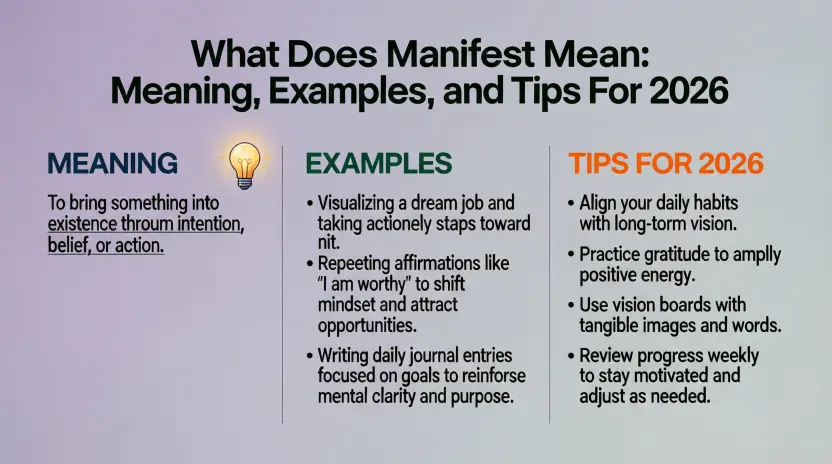
The word “manifest” is one of those versatile terms that can mean different things depending on context.
You might hear it in everyday conversations, in legal documents, or in discussions about spirituality and personal growth.
But what does it actually mean? At its core, to manifest means to make something clear, obvious, or visible. It can describe the act of showing or displaying something, or the state of being apparent.
For example, a person’s confidence may manifest in the way they speak, or a shipping company may prepare a manifest listing all cargo on board.
In spiritual terms, manifestation often refers to bringing your intentions, goals, or desires into reality.
Understanding the different meanings, usages, and nuances of manifest can help you communicate more effectively, read documents accurately, and even explore techniques for personal manifestation.
In this article, we’ll break it all down with definitions, examples, and practical tips.
General Definition of Manifest
The word “manifest” is a versatile term that can function as a verb, noun, or adjective, depending on the context.
At its core, it means something clear, obvious, or able to be seen. According to standard dictionaries, to manifest is to display or show something clearly, making it apparent to others. The origin of the word comes from the Latin term “manifestus,” which literally translates to “obvious” or “evident.” This highlights the consistent theme of clarity and visibility in all its uses.
As an adjective, manifest describes something that is clearly visible or easily recognized. For example, one might say, “Her excitement was manifest in her smile,” meaning her happiness was obvious to everyone.
As a verb, manifest refers to the act of making something evident or bringing it into reality. For instance, “He manifested his ideas through his artwork,” demonstrates that his creativity was made visible or expressed.
As a noun, manifest is often used in legal, shipping, or transportation contexts. A cargo manifest or passenger manifest is a list that clearly shows all items or people being transported.
Understanding the general definition of manifest is the first step toward using it correctly in everyday language, legal documents, and even spiritual practices.
By recognizing the core idea making something clear or evident you can confidently apply the word in multiple contexts.
Manifest as a Verb
When used as a verb, the word manifest means to show, display, or make something evident. It describes the action of bringing thoughts, feelings, ideas, or intentions into a visible or tangible form.
In everyday language, we often use it to describe how emotions or qualities become apparent through actions or behavior.
For example, someone’s patience may manifest in how they calmly handle a stressful situation, or kindness may manifest through acts of generosity.
In addition to daily usage, manifesting as a verb is widely recognized in spiritual and personal development contexts.
Here, it refers to turning thoughts, desires, or intentions into reality.
For instance, when people say they are “manifesting their goals,” they mean they are actively working to bring their dreams into existence by aligning thoughts, beliefs, and actions.
In professional or academic contexts, manifesting can also mean demonstrating evidence or proof of something. For example, symptoms can manifest in a patient’s behavior, or a problem may manifest as a pattern in data.
Some example sentences include:
- “Her dedication to her work manifested in outstanding results.”
- “They hoped to manifest change through community activism.”
- “Symptoms of the illness manifested gradually over several weeks.”
By understanding manifest as a verb, you can effectively describe actions, evidence, or the process of making ideas real, whether in writing, speech, or spiritual practices.
This versatility makes the verb form one of the most commonly used and important ways to apply the word.
Manifest as an Adjective
When used as an adjective, manifest describes something that is clear, obvious, or easily perceived. In this form, it highlights the evident nature of a quality, condition, or situation, leaving little room for doubt or confusion.
Essentially, it emphasizes that whatever is being described is plainly visible or unmistakable.
For example, you might say, “Her frustration was manifest in her tone of voice.”
This means that her irritation was clearly observable without needing further explanation.
Similarly, in a professional setting, one could note, “The benefits of the new policy were manifest,” indicating that the advantages were obvious to everyone affected.
The adjective form of manifest is also common in legal, scientific, and formal writing. For instance, one might write, “There was manifest evidence of negligence,” to convey that the proof was conspicuously clear. Using manifest in this way adds a tone of authority and precision, making it especially suitable for academic or official contexts.
Some other examples include:
- “The joy on their faces was manifest to all present.”
- “The risks of the project were manifest but overlooked.”
- “Her talent was manifest even at a young age.”
By understanding manifest as an adjective, you can describe observable qualities, emotions, or facts with clarity and impact.
This form is particularly useful when you want to emphasize that something is evident and undeniable, making your writing or speech more precise and expressive.
Manifest as a Noun
When used as a noun, manifest typically refers to an official document or list that details items, goods, or people being transported.
This usage is most common in shipping, transportation, and legal contexts, where clarity and accuracy are essential.
A manifest provides a clear record of what is included, making it easier to track, manage, and verify shipments or passengers.
For example, a cargo manifest lists all the goods being transported on a ship, truck, or plane. Each item is described in detail, often including weight, quantity, and description.
Similarly, a passenger manifest lists the names of all passengers on a flight or vessel, which is crucial for safety, accountability, and legal purposes.
In legal situations, a manifest can also be a record of evidence or an official declaration of items.
Example sentences include:
- “The shipping company prepared a manifest for all cargo before departure.”
- “Customs officers checked the manifest to verify the shipment contents.”
- “The passenger manifest confirmed that everyone had boarded safely.”
Using manifest as a noun emphasizes organization, transparency, and accountability. Unlike its verb and adjective forms, this usage is formal and administrative, but it’s widely recognized and essential in professional contexts.
Understanding all three forms of manifest verb, adjective, and noun helps you see its versatility.
Whether you are describing an action, a quality, or creating a record, manifest allows you to communicate clearly and effectively across different situations.
Manifest in Law and Official Documents
In legal and official contexts, the term manifest is most commonly used as a noun, referring to a detailed record or list that ensures accuracy, accountability, and transparency.
This usage is especially important in shipping, transportation, and administrative procedures, where every item or individual must be properly documented.
A cargo manifest is a classic example. It lists all goods being transported, including their quantity, description, and weight.
Shipping companies rely on these manifests to verify cargo, prevent loss, and comply with customs regulations.
Similarly, a passenger manifest lists all individuals traveling on a plane, ship, or bus. This document is crucial for safety, legal compliance, and emergency management, as authorities need an accurate record of everyone on board.
In legal cases, the word manifest can also refer to evidence that is clearly apparent or obvious.
For example, a judge may comment on the “manifest negligence” of a party, meaning that the evidence of wrongdoing is clear and indisputable.
Example sentences include:
- “The shipping manifest was reviewed by customs before clearance.”
- “All passengers were accounted for in the flight manifest.”
- “The court found manifest errors in the contract that required correction.”
Understanding manifest in law and official documents highlights its role in formal record-keeping and legal clarity.
Unlike everyday or spiritual uses, this application emphasizes precision, verification, and accountability, making manifest an indispensable term in administrative and legal settings.
Manifest in Spirituality and Personal Development
In the context of spirituality and personal development, the term manifest takes on a more metaphorical and aspirational meaning.
Here, to manifest is to bring desires, intentions, or goals into reality through focused thought, belief, and action.
This concept is closely associated with the law of attraction, a principle suggesting that positive or negative thoughts can influence outcomes in a person’s life.
Manifesting in this sense is not merely wishful thinking; it involves clarifying your goals, visualizing the desired outcome, and taking intentional steps toward achieving it.
For example, someone might say, “I am manifesting a successful career,” which implies that they are actively aligning their mindset, planning, and efforts to create that reality.
Practical examples of manifesting include:
- Writing a vision board to visualize life goals.
- Using affirmations to reinforce positive beliefs.
- Taking consistent actions that align with desired outcomes.
Spiritual practitioners often view manifesting as a bridge between intention and tangible results. It emphasizes awareness, mindfulness, and alignment with one’s values and aspirations.
Example sentences include:
- “She manifested her dream home after months of focused planning.”
- “By manifesting confidence, he overcame his fears and spoke publicly.”
- “They practiced daily affirmations to manifest success in their business.”
Understanding manifest in spirituality and personal growth shows how the word extends beyond literal or legal definitions.
It becomes a tool for personal empowerment, clarity of intention, and purposeful action, helping individuals transform their vision into reality.
Common Phrases and Idioms Using Manifest
The word manifest appears in several common phrases and idioms, each with its own meaning depending on the context.
Understanding these expressions can help you interpret writing, speeches, and historical texts more accurately.
One of the most famous phrases is “Manifest Destiny,” which originated in 19th-century America. It referred to the widely held belief that the United States was destined to expand across the North American continent.
Here, manifest emphasizes something seen as obvious or inevitable.
Another common use is “manifest evidence” or “clearly manifest,” often found in legal, academic, or formal writing.
These phrases mean that something is evident, clear, or undeniable. For example, “The benefits of the new policy were manifest to all employees” suggests that the advantages were obvious and easily recognized.
In everyday speech, you might encounter phrases like:
- “Her excitement was manifest in every gesture.”
- “The error was manifest from the very first calculation.”
- “The company’s dedication to quality is manifest in its products.”
These idioms and phrases show how manifest can emphasize clarity, visibility, and evidence. Whether used in historical, legal, or casual contexts, these expressions make writing and speech more precise and impactful.
By learning these phrases, you not only understand the meaning of manifest, but also how to use it naturally in conversation and writing.
They demonstrate the word’s versatility, from everyday emotions to historical and professional contexts, enriching your vocabulary and communication skills.
Manifest vs. Similar Words
Understanding manifest also means distinguishing it from words with similar meanings, such as demonstrate, reveal, evident, and obvious. While these words are related, subtle differences in usage and context make manifest unique.
As a verb, manifest emphasizes making something clearly visible or bringing it into reality. For example, “Her dedication manifested in her achievements” suggests that her hard work became clearly evident through results.
In comparison, demonstrate often emphasizes showing through action or proof, such as “He demonstrated his skills during the presentation.”
The difference is subtle: manifest highlights the natural appearance or effect, while demonstrate emphasizes intentional proof or display.
As an adjective, manifest means obvious or plainly visible, similar to evident or obvious.
For instance, “The risks were manifest” conveys that they were clearly observable. While evident and obvious can replace manifest in casual writing, manifest is more formal and precise, often used in legal, academic, or professional contexts.
Example sentences for comparison:
- Manifest: “Her joy was manifest in her smile.”
- Demonstrate: “She demonstrated her joy by dancing.”
- Evident: “Her joy was evident to everyone.”
- Obvious: “It was obvious she was happy.”
By comparing manifest with similar words, you can choose the best term for your context, whether writing formally, speaking professionally, or expressing emotions in everyday situations. Manifest stands out for its clarity, versatility, and formal tone, making it a valuable addition to any vocabulary.
Synonyms and Antonyms of Manifest
Understanding the synonyms and antonyms of manifest can help expand your vocabulary and improve precision in writing and speaking.
Since manifest can function as a verb, adjective, or noun, its synonyms and antonyms vary slightly depending on the form and context.
Common synonyms for manifest include:
- Evident – clearly seen or understood, e.g., “The results were evident to all.”
- Obvious – easy to perceive, e.g., “Her excitement was obvious.”
- Apparent – visible or easily understood, e.g., “The benefits were apparent.”
- Display – to show or exhibit, e.g., “He displayed his artwork at the gallery.”
- Reveal – to make something known or visible, e.g., “The investigation revealed the truth.”
These synonyms are useful when you want to emphasize clarity or visibility, whether describing emotions, evidence, or actions.
Common antonyms of manifest include:
- Hidden – not visible or noticeable, e.g., “The solution remained hidden.”
- Obscure – unclear or difficult to perceive, e.g., “The meaning of the text was obscure.”
- Secret – deliberately concealed, e.g., “The plans were kept secret.”
- Unclear – not obvious or definite, e.g., “The instructions were unclear.”
By knowing these synonyms and antonyms, you can choose the word that best fits your context. For formal writing, “manifest” adds precision and authority, while casual alternatives like “obvious” or “evident” may feel more approachable. Using the correct word ensures your message is clear, accurate, and contextually appropriate.
How to Use Manifest in Writing and Speaking
Using manifest effectively in writing and speech requires understanding its different forms and contexts. Whether as a verb, adjective, or noun, manifest adds clarity, precision, and sophistication to your communication.
As a verb, manifest is often used to describe making something evident or bringing it into reality. For example, “Her confidence manifested in the way she led the team.”
This usage works well in both formal writing (reports, essays) and personal growth contexts (self-improvement, spirituality). When speaking, you can use manifest to emphasize visible results or outcomes.
As an adjective, manifest describes something obvious or clearly perceivable. For instance, “The benefits of the plan were manifest.” This form is particularly useful in professional, legal, or academic writing, where precise language is required.
In everyday conversation, it can replace phrases like “clearly visible” or “obvious,” giving your speech a slightly more formal tone.
As a noun, manifest is mainly used in official or administrative contexts, such as shipping or transportation. Example: “The flight manifest listed all passengers on board.” This usage is more specialized but essential for legal accuracy and record-keeping.
Tips for using manifest effectively:
- Match the form to the context: verb for action, adjective for clarity, noun for official lists.
- Avoid overuse; use manifest where emphasis or precision is needed.
- Pair with examples, actions, or evidence to strengthen clarity.
By mastering these usages, you can enhance both written and spoken communication, making your expression more precise, formal, and versatile.
FAQs About Manifest
Here are some frequently asked questions about manifest, covering its meanings, usage, and contexts:
1. What does it mean to manifest your dreams?
To manifest your dreams means to actively bring your desires or goals into reality. This involves clarifying your intentions, visualizing the outcome, and taking aligned actions. It is commonly used in spiritual and personal growth contexts.
2. Is manifest a noun, verb, or adjective?
Manifest can be all three:
- As a verb, it means to make something visible or evident (e.g., “Her dedication manifested in her work”).
- As an adjective, it describes something obvious or clear (e.g., “The risks were manifest”).
- As a noun, it refers to a document listing items or people, often in shipping or travel (e.g., “The cargo manifest was reviewed by customs”).
3. What is a cargo or passenger manifest?
A cargo manifest lists all goods on a shipment, while a passenger manifest lists all travelers on a plane, ship, or bus. These documents are crucial for tracking, accountability, and legal compliance.
4. How do I use manifest in a sentence?
Examples include:
- “Her talent was manifest from an early age.”
- “The company’s commitment to quality manifested in its products.”
- “The shipping manifest listed every item in the container.”
5. What is the difference between manifest and demonstrate?
Manifest emphasizes something becoming evident or visible, often naturally or over time. Demonstrate emphasizes actively showing or proving something.
Understanding these FAQs helps clarify all forms, contexts, and correct usage of manifest, making it easier to apply in writing, conversation, and professional settings.
Conclusion
The word manifest is a versatile term with multiple meanings and uses, making it a powerful addition to your vocabulary.
Whether used as a verb, adjective, or noun, manifest consistently conveys the idea of clarity, visibility, or evidence.
As a verb, it describes the act of making something evident or bringing intentions into reality.
As an adjective, it highlights qualities that are obvious or easily observable.
As a noun, it serves a practical role in legal, shipping, and administrative contexts, listing items or people in an official document.
Beyond everyday and professional uses, manifest also holds significance in spirituality and personal development, where it describes the process of turning goals, dreams, or intentions into reality.
Phrases like “manifest destiny” or “manifest evidence” demonstrate how its meaning adapts across history, law, and literature.
By understanding the definitions, contexts, synonyms, antonyms, and idioms, you can use manifest accurately in writing, speech, and professional settings.
Whether you are describing emotions, documenting information, or exploring personal growth, manifest allows you to communicate clearly, precisely, and effectively.
Embrace its versatility, practice its usage, and watch how it can enhance your expression in multiple areas of life.

Bella Banter is the voice behind ThePunSide.com, creating clever puns, cute captions, and feel-good humor for everyday moments. With a mix of soft vibes and witty banter, Bella turns simple words into smiles. If you love smart jokes, playful lines, and cozy creative energy, you’re in the right place.