Temperature measurement sounds simple until you’re standing in front of a 1600°C furnace, a cryogenic storage tank, or a high-pressure reactor. The sensor you pick in that moment matters more than most people realize. Get it wrong and you’re looking at inaccurate readings, early sensor failure, or worse, a process that runs completely blind.
Thermoelement, also known as thermocouples, are the most widely used temperature sensors in industry. They’re durable, they cover an enormous range (from -200°C all the way up to 2320°C), and they work on a principle that’s been trusted for well over a century.
How a thermocouple works
Two wires of different metals are joined at one end. That junction point — the “hot junction” — sits inside the process being measured. The other end, the “cold junction,” connects to your measurement system.
When there’s a temperature difference between the two junctions, a small voltage is produced. That voltage is the Seebeck Effect in action. The measurement system reads this voltage and converts it into a temperature value.
One thing worth noting: a thermocouple measures the temperature difference between its two junctions, not an absolute temperature. That’s why cold junction compensation is necessary for accurate readings. The working range for thermocouples runs from -200°C to 2320°C depending on the type.
Base metal thermocouples
Type K (Chromel/Alumel)
Type K is, by far, the most commonly specified thermocouple. The positive leg is Chromel (a nickel-chromium alloy) and the negative leg is Alumel (nickel-aluminum). The measurement range runs from about -200°C up to 1260°C, making it a sensible default for a wide variety of process applications.
Steel manufacturing, glass furnaces, HVAC systems, laboratory equipment, power plants — Type K shows up in all of them. It performs well in oxidizing atmospheres, which is why it’s the go-to choice for furnace environments.
One limitation: above 850°C, Type K can drift over time in certain atmospheric conditions. For applications that demand long-term stability at high temperatures, Type N is a better option.
Type N (Nicrosil/Nisil)
Type N was specifically developed to address the stability issues of Type K at elevated temperatures. The alloy combination — Nicrosil for the positive leg, Nisil for the negative — gives it noticeably better performance above 1000°C. The full range is similar to Type K, but the drift over time is much lower.
If your application runs a furnace continuously at high temperatures, or if accuracy needs to hold steady over long operating periods, Type N is worth considering over Type K. Steel production and high-temperature industrial furnaces are where Type N earns its place.
Type J (Iron/Constantan)
Type J uses iron on the positive leg and a copper-nickel alloy (Constantan) on the negative. The working range is -40°C to 750°C. At 770°C, iron hits something called the Curie Point — a molecular change that permanently affects the sensor’s output. That’s the hard ceiling.
Type J works well in reducing atmospheres and vacuum environments where Type K would degrade. It’s a practical choice for legacy equipment too, since it’s been in use for decades and remains common in older industrial setups.
Keep it away from moisture. The iron leg rusts, and a corroded sensor is an inaccurate one.
Type T (Copper/Constantan)
Type T is the one you reach for when the process is cold. Very cold. The range goes from -200°C up to about 350°C, and it performs well in cryogenic applications where other types struggle.
It also handles humid environments better than most. The combination of copper and Constantan is relatively stable in wet conditions, making it suitable for food processing, refrigeration systems, and low-temperature laboratory work.
Type E (Chromel/Constantan)
Type E produces the highest EMF output per degree of all the standard thermocouple types. In practical terms, that means better sensitivity and easier signal detection. The range is -200°C to 900°C.
It works best in mildly oxidizing and inert environments. Not a common first choice for general use, but for applications where signal strength and sensitivity matter, it’s a genuine option.
Mineral insulated thermocouples
The construction of a thermocouple is just as important as the element type. Mineral insulated (MI) thermocouples, sometimes called MgO thermocouples, use compacted magnesium oxide powder to insulate the element wires inside a metal sheath.
The result is a sensor that’s physically tough, bendable, and able to operate in difficult environments where an open-wire thermocouple would fail quickly.
Tempsens manufactures MI thermocouples in Types J, K, T, E, and N. Sheath diameters are available in 3mm, 4.5mm, 6mm, 8mm, and 10mm, with other sizes produced on request. Sheath materials include SS321, SS316, SS310, Inconel 600, Inconel 601, Platinum, Pyrosil, Nimonic, and HRS 446 among others.
Configuration options cover simplex, duplex, and multipoint setups. Specialised versions built to ASTM E235 are also available for nuclear applications.
MI thermocouples show up in vibration-heavy environments, tight installation spaces, high-pressure lines, and anywhere a standard probe would be too fragile or too large. The bendable nature of the sheath means they can follow awkward routes through equipment without losing performance.
Refractory metal thermocouples
Some applications go beyond what platinum can handle. Vacuum furnaces, nuclear environments, and certain metallurgical processes operate at temperatures that would destroy a noble metal sensor. That’s where tungsten-rhenium thermocouples come in.
Types C, D, and G use tungsten and rhenium in various combinations. Type C, for example, uses 95% tungsten/5% rhenium on the positive side and 74% tungsten/26% rhenium on the negative. The usable range extends to 2320°C.
These are not general-purpose sensors. Tungsten-rhenium alloys are brittle, expensive, and must be used in inert, vacuum, or non-oxidizing environments. Exposure to oxygen at operating temperatures will destroy them quickly. But for applications where nothing else gets close to the required temperature range, they’re the only option.
Tempsens supplies Type C, D, and G thermocouples for vacuum furnace and ultra-high-temperature applications.
Construction
- Junction types: A grounded junction bonds the element wires to the sheath tip, giving fast response but making the element electrically connected to the sheath. An ungrounded junction isolates the elements from the sheath, which reduces electrical interference. An exposed junction (no sheath at the tip) gives the fastest response of all but offers no protection, so it’s only used in clean, non-corrosive environments.
- Sheath materials: The sheath has to survive the process conditions independently of the sensing element. For general use, stainless steel grades like SS316 work fine. Corrosive or very high-temperature environments often need Inconel 600 or 601, Nimonic alloys, or ceramic materials.
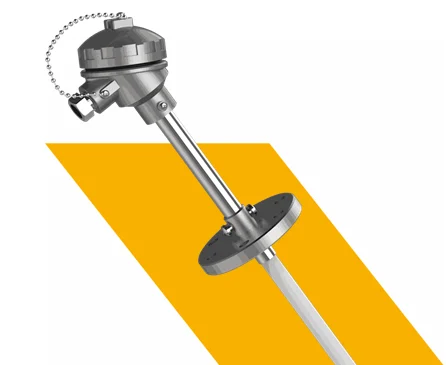
- Head and termination styles: Tempsens offers thermocouples with weather-proof IP-67 die-cast aluminium heads, ceramic terminal blocks, cable and connector options with Teflon-insulated flexible cable, nipple-union-nipple configurations for easy sensor replacement, and tip assemblies specifically designed to improve junction life in vibration-prone installations.
Choosing the right thermocouple/thermoelement
- What temperature range does the application cover? That alone rules out many options.
- What’s the atmosphere? Oxidizing, reducing, vacuum, or inert conditions each suit different element types.
- Does the sensor need to survive vibration, pressure, or chemical attack? Construction matters here more than element type.
- How long does it need to last, and how much drift is acceptable? High-temperature stability is where Types N and B earn their cost difference over Types K and J.
- Is the measurement a single point, or does the process need profiling at multiple depths? Multipoint designs exist for the latter.
Tempsens produces the full range of thermocouple types covered in this article — base metal, mineral insulated, noble metal, refractory metal, and custom special designs — along with the extension cables, mineral insulated cables, and thermocouple alloy conductors that complete a measurement installation.
Getting the specification right before ordering saves time, cost, and the frustration of premature sensor replacement. The range of options available means there’s a configuration built for almost any process condition — the work is in matching the right one to the job.