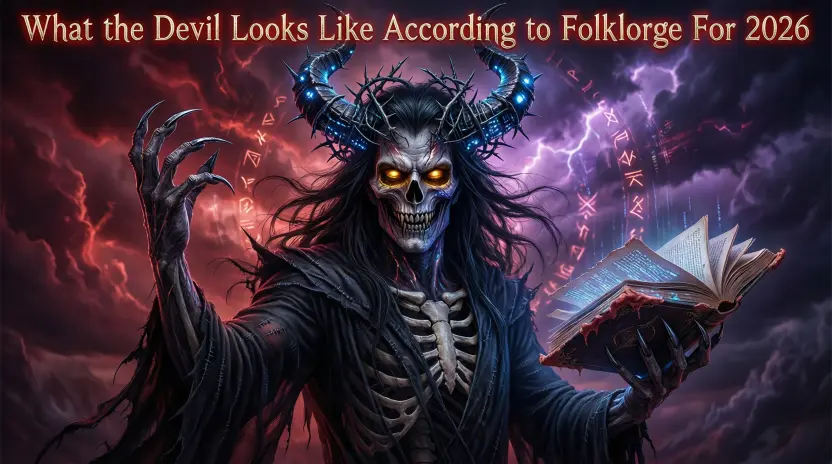
The Devil has fascinated, terrified, and intrigued humans for centuries. Across religions, cultures, and centuries of art, his appearance has been described in countless ways, sometimes horrifying, sometimes deceptively charming.
But what does the Devil really look like? Is he the red-skinned, horned figure of cartoons and Halloween, or something far more subtle, even human-like?
From the Bible’s warnings to medieval artists’ dramatic depictions, and from Islamic texts describing Iblis to modern movies and literature, the Devil’s image has evolved dramatically.
Each depiction carries symbolism, lessons, and cultural meaning that reveal more about human fears and imagination than about an actual form.
In this guide, we’ll explore the Devil’s appearance from multiple perspectives:
religious, historical, artistic, and modern pop culture answering the question once and for all, while uncovering the fascinating story behind the most iconic image of evil ever imagined.
The Devil in Christianity
In Christianity, the Devil is often depicted as the ultimate embodiment of evil, but the Bible itself gives surprisingly few physical descriptions.
The term “Satan” originally means “adversary” or “accuser,” and many references focus on his role rather than his appearance.
Early biblical texts describe him as a fallen angel who rebelled against God, which suggests he may have once been beautiful and radiant.
Over time, artists and theologians added details to convey his evil nature: red skin, horns, a pointed tail, and cloven hooves became popular symbols.
These features were never in the original scripture but served as visual cues of sin, danger, and temptation.
The Devil is also portrayed as a deceiver, capable of appearing human or even charming, highlighting the Christian idea that evil can be subtle and misleading.
In literature, sermons, and iconography, these depictions reinforced moral lessons, warning believers of the consequences of sin.
Today, the red, horned Devil remains iconic, but understanding its evolution reveals that the image is as much cultural and symbolic as it is religious.
The Devil in Islam (Iblis/Shaitan)
In Islam, the Devil is primarily known as Iblis or Shaitan, and his role differs slightly from Christian depictions.
According to the Quran, Iblis was a jinn who refused to bow to Adam, disobeying God’s command.
Unlike the Christian Devil, Islamic texts do not focus on grotesque features like horns, tails, or red skin. Instead, Iblis’s appearance is less important than his function: he is a deceiver, whispering evil thoughts into human hearts and leading people astray.
Some traditions suggest that Shaitan can appear in many forms, sometimes even appearing attractive to trick humans, emphasizing his cunning and manipulative nature.
Islamic scholars often stress that his true form is invisible to humans, highlighting the symbolic nature of his role as a test of faith.
Over time, cultural representations in Islamic art and literature have sometimes borrowed elements from other traditions, but the core message remains: Iblis is a spiritual adversary, embodying temptation and rebellion against God.
Understanding his depiction in Islam shows that the Devil’s image is often symbolic, representing inner struggle rather than a fixed physical form.
Jewish Perspectives on the Devil
In Judaism, the concept of the Devil is quite different from the dramatic images often seen in Christianity.
The Hebrew Bible refers to Satan not as a purely evil being, but as an “accuser” or adversary, often serving as a tester of faith.
For example, in the Book of Job, Satan challenges Job’s righteousness under God’s permission, highlighting a role that is more judicial than malevolent.
Physical descriptions of the Devil are largely absent in Jewish texts, which emphasizes his symbolic rather than literal existence. Later Jewish folklore, such as in the Talmud and mystical writings, introduces more imaginative depictions, sometimes portraying him with frightening or animal-like features, yet these are rarely standardized.
Symbolically, the Devil represents human struggle with temptation, sin, and moral choices, rather than a singular monstrous form.
This perspective influenced later Christian and cultural depictions, showing how the Devil’s image evolved over time.
Understanding the Jewish viewpoint reminds us that the Devil’s appearance is not fixed; it is deeply tied to moral and spiritual lessons, reflecting internal human challenges rather than a universally terrifying figure.
Medieval and Renaissance Art Depictions
During the Medieval and Renaissance periods, artists played a huge role in shaping the image of the Devil that many people recognize today.
Since most of the population was illiterate, visual art became a primary tool for teaching about sin, evil, and divine punishment. Medieval depictions often exaggerated monstrous features: horns, wings, tails, claws, and fiery red skin to instill fear and convey the Devil’s malevolent nature.
These characteristics were not based on scripture but on symbolism: horns represented power and pagan connections, tails emphasized animalistic instincts, and wings suggested a fallen angel once part of heaven.
Renaissance artists introduced more sophisticated imagery, sometimes giving the Devil a human-like form, blending beauty and terror to reflect the concept of deception.
Famous works, such as Hieronymus Bosch’s “The Garden of Earthly Delights” or Pieter Bruegel’s “The Fall of the Rebel Angels,” show the Devil as grotesque, chaotic, and symbolic of moral corruption.
These artistic interpretations influenced Western culture for centuries, cementing the red, horned Devil as an enduring symbol.
Understanding these depictions highlights that the Devil’s appearance is largely shaped by artistic imagination and moral storytelling rather than literal description.
Symbolism Behind the Devil’s Features
Many of the Devil’s most recognizable features are symbolic, designed to convey moral lessons rather than depict a literal form.
Red skin, for example, has long represented danger, anger, and sin, evoking fear and alerting viewers to evil.
Horns are another common attribute, borrowed from pagan gods and ancient mythological creatures, symbolizing power, aggression, and a connection to the animalistic or primal side of humanity.
The tail often signifies temptation and base instincts, reminding people of the Devil’s cunning and deceptive nature.
Similarly, cloven hooves reinforce the idea of an unnatural, bestial presence, separating him from the divine or human realm.
The pitchfork, sometimes called a trident, originated as a farming tool symbolically repurposed to “punish” sinners in hell.
Wings, particularly bat-like, reference the Devil’s status as a fallen angel, once celestial but now cast into darkness. Even beauty can be symbolic; when the Devil is depicted as attractive or charming, it warns of the danger of temptation and deception.
Understanding these features reveals that the Devil’s appearance is a language of morality, conveying spiritual lessons visually and culturally across generations.
The Devil in Literature and Pop Culture
Beyond religious texts and classical art, the Devil has become a major figure in literature, movies, and popular culture.
Writers, filmmakers, and artists often portray him in ways that reflect society’s fears, desires, and moral lessons. In literature, from Dante’s Inferno to Goethe’s Faust, the Devil is depicted as a tempter, a cunning trickster, or a being who challenges human morality.
These portrayals often combine terrifying and alluring traits, emphasizing his role as a deceiver. In modern movies and television, the Devil ranges from grotesque monsters with horns and red skin to suave, charming characters, as seen in films like The Devil’s Advocate or shows like Lucifer.
Comics and video games also expand his image, often emphasizing supernatural powers, dramatic wings, and fire-themed aesthetics.
Pop culture frequently borrows traditional symbols horns, tails, pitchforks but adapts them for entertainment, sometimes softening his frightening aspects.
These portrayals shape public perception, making the Devil both a figure of horror and fascination.
Studying literature and pop culture demonstrates that the Devil’s appearance is flexible, evolving with each generation to reflect human fears, morality, and imagination.
Can the Devil Appear Beautiful or Human-Like?
Throughout history, many traditions suggest that the Devil can appear beautiful or deceptively human.
In Christianity, he is often described as a fallen angel who was once radiant and perfect, implying that his true form could be charming rather than grotesque.
This aligns with the idea that evil can be subtle and seductive, capable of misleading humans through appearances.
Literature and folklore frequently reinforce this concept: the Devil may take the form of a stranger, a wealthy patron, or a charismatic figure to tempt individuals into sin. In Islam, Iblis or Shaitan is also said to sometimes assume attractive forms to deceive humans, emphasizing cunning over physical horror.
Even in modern films and media, the Devil is often portrayed as suave, intelligent, or appealing, showing that fear is not only about physical monstrosity but also about moral danger.
This duality highlights a deeper symbolic meaning: the Devil’s beauty or human-like traits serve as a warning about temptation and the deceptive nature of evil, reminding people to look beyond appearances and recognize the moral consequences of their choices.
Myth vs. Reality: Is There a “True” Appearance?
The question of the Devil’s true appearance is complex, as interpretations vary across religion, culture, and history.
In most traditions, the Devil is not meant to have a fixed, literal form; rather, his image is symbolic, representing evil, temptation, and the human struggle with morality.
In Christianity, descriptions of Satan range from a fallen angel to a red, horned demon, while in Islam, Iblis is largely unseen, acting through whispers and deception rather than physical terror.
Jewish texts portray Satan as an accuser or tester, again emphasizing function over form.
Over time, art, literature, and folklore added vivid details, horns, tails, wings, and fire shaping public imagination, but these are cultural interpretations rather than definitive appearances.
Modern media has further diversified the Devil’s image, from monstrous to charming, showing that fear and fascination are often projected onto him.
Ultimately, the “true” appearance of the Devil may not exist outside human perception. Understanding this distinction helps us recognize that depictions of the Devil reveal more about human fears, moral lessons, and creativity than about a literal form.
FAQs
What does Satan look like in the Bible?
The Bible provides few physical descriptions. Satan is often portrayed as a fallen angel, emphasizing his role as an accuser and tempter rather than detailing monstrous features. Over time, artists added horns, tails, and red skin to symbolize evil.
Why is the Devil often shown with horns and a tail?
Horns and tails are symbolic. Horns represent power, aggression, and links to pagan deities, while tails emphasize animalistic instincts and deception. These features are visual tools to illustrate sin and danger.
Did the Devil used to be an angel?
Yes. In Christian tradition, the Devil was once a radiant angel who rebelled against God. This explains depictions of him with wings and beauty, reminding believers that evil can be alluring.
Are there different appearances in other religions?
Absolutely. In Islam, Iblis (Shaitan) is mostly invisible, acting as a deceiver. Jewish texts portray Satan as an accuser or tester, without emphasizing monstrous features. Cultural and artistic interpretations vary widely.
Why is the Devil sometimes depicted as attractive?
Evil is often portrayed as deceptive. A beautiful or human-like Devil symbolizes temptation, illustrating that danger is not always obvious. This appears in folklore, literature, and modern media to warn of moral pitfalls.
These FAQs address the most common curiosities, clarifying misconceptions while providing symbolic, religious, and cultural context. They reinforce that the Devil’s appearance is as much a reflection of human imagination and morality as it is a literal form.
Conclusion
The Devil’s appearance has fascinated and terrified humanity for centuries, yet the truth is far more symbolic than literal.
Across religions, cultures, and history, his image has evolved to reflect moral lessons, human fears, and artistic imagination rather than a definitive form.
In Christianity, Satan is portrayed as a fallen angel, sometimes grotesque, sometimes deceptively beautiful, teaching lessons about temptation and sin.
In Islam, Iblis or Shaitan is largely invisible, emphasizing spiritual deception over physical horror.
Jewish texts view Satan as an accuser, testing human morality rather than embodying pure evil in a monstrous form.
Art, literature, and modern media have further shaped the Devil’s image, adding horns, tails, wings, and other symbolic features.
Even in pop culture, he can be terrifying, alluring, or charming, showing the flexibility of his portrayal.
The Devil’s diverse appearances, red-skinned, human-like, or completely invisible highlight that these depictions are reflections of human imagination and cultural storytelling.
Ultimately, asking “What does the Devil look like?” is less about discovering a fixed image and more about understanding the ideas, fears, and lessons humanity projects onto the concept of evil.
By exploring his appearances across history, religion, and media, we gain insight not only into cultural beliefs but also into the universal struggle between temptation, morality, and human nature.

Maya Memez — Bringing you daily memes, relatable chaos, and nonstop laughter. From viral trends to original humor, this page serves pure entertainment for anyone who loves to smile, scroll, and share. Powered by ThePunSide.com for even more jokes, fun, and meme magic every single day.