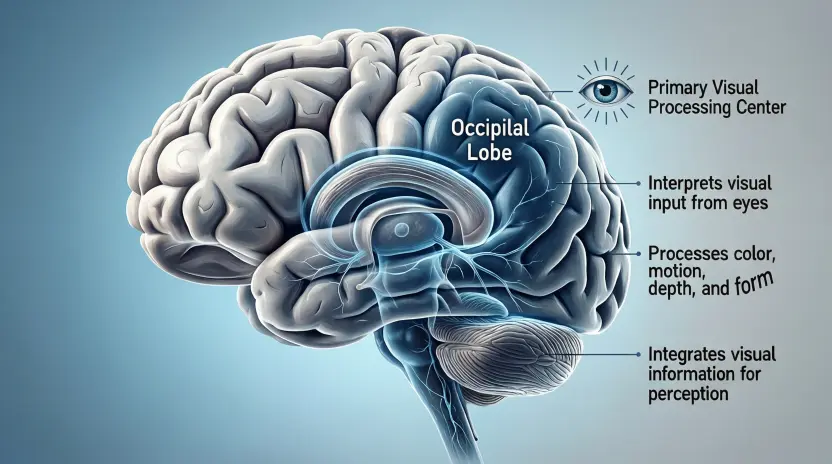
The human brain is an extraordinary organ, and each of its lobes plays a unique role in controlling how we think, feel, and perceive the world.
Among these, the occipital lobe stands out as the brain’s primary center for vision.
Located at the very back of the brain, this lobe is responsible for interpreting the information our eyes send, turning light, color, and shapes into the images we recognize every day.
From reading a book to identifying a friend in a crowd, the occipital lobe ensures our visual experiences are seamless and meaningful.
But its role goes beyond simple sight; it also helps with visual memory, spatial awareness, and even motion detection.
Understanding what the occipital lobe does not only reveals the complexity of the human brain but also highlights how vital this love is to navigating and interacting with the world around us.
Anatomy of the Occipital Lobe
The occipital lobe is the smallest of the four main lobes of the cerebral cortex, yet it plays an outsized role in how we perceive the world. Located at the back of the brain, just above the cerebellum, it is bordered by the parietal lobe on top and the temporal lobe on the sides. Despite its compact size, the occipital lobe is highly specialized, containing several distinct regions that work together to process visual information efficiently.
The most critical part is the primary visual cortex (V1), also known as the striate cortex, which receives raw visual data directly from the eyes via the optic nerves and thalamus. Surrounding V1 are the secondary visual areas V2, V3, V4, and V5 which interpret different aspects of vision, such as color, motion, and shape. For example, the cuneus is responsible for basic visual processing, while the lingual gyrus helps with recognizing letters and words.
Another important region is the calcarine cortex, which handles fine visual details and spatial orientation. Together, these structures allow the occipital lobe to transform electrical signals from the eyes into meaningful images that the brain can understand. Understanding the anatomy of the occipital lobe provides a foundation for exploring how it functions and why it is essential for everyday tasks like reading, driving, or even appreciating a sunset.
Functions of the Occipital Lobe
The occipital lobe serves as the brain’s primary visual processing center, making it essential for interpreting the world around us. Its main function is to receive signals from the eyes and transform them into images, allowing us to understand shapes, colors, movement, and spatial relationships. Every visual detail we notice from reading a book to recognizing a familiar face relies heavily on the occipital lobe’s efficiency.
The primary visual cortex (V1), located within the occipital lobe, first processes basic visual information such as edges, light, and contrast. From there, the information moves to the secondary visual areas (V2–V5), which handle more complex aspects of vision. For instance, V4 is responsible for color perception, while V5 processes motion and helps the brain track moving objects.
Beyond pure vision, the occipital lobe contributes to visual memory and spatial awareness, helping us navigate environments and remember locations. It also interacts with other lobes: the parietal lobe assists with spatial orientation, while the temporal lobe aids in recognizing objects and faces.
Damage to this lobe can lead to difficulties such as visual agnosia, where the brain cannot recognize objects, or cortical blindness, a rare condition where a person loses conscious visual perception. Clearly, the occipital lobe is not just about seeing, it’s about understanding and interpreting everything we view in our daily lives.
The Visual Cortex: The Core Processor
At the heart of the occipital lobe lies the visual cortex, the specialized region responsible for interpreting the raw visual information sent from the eyes. Often referred to as the brain’s “visual processor,” the visual cortex ensures that light, color, shapes, and movement are transformed into coherent images we can understand.
The primary visual cortex (V1) is the first stop for visual signals. It detects fundamental visual elements, such as edges, lines, orientation, and brightness. Essentially, V1 creates the blueprint for everything we see. Surrounding V1 are the secondary visual areas V2, V3, V4, and V5 each with a unique function. V2 refines patterns and textures, V3 processes form and depth, V4 specializes in color perception, and V5 (also called MT) handles motion detection. These areas work together in a complex network, allowing the brain to interpret dynamic and detailed visual scenes.
The visual cortex also communicates with other parts of the brain. For example, the temporal lobe assists in identifying objects and faces, while the parietal lobe helps determine spatial orientation and movement. This coordination ensures that what we see is not only clear but meaningful, enabling activities like driving, sports, or even navigating crowded streets.
In short, the visual cortex transforms electrical signals from the eyes into the images and motions we experience every day, making it a central player in understanding what the occipital lobe does. Without it, the world would appear as a blur of indistinct shapes and colors.
How the Occipital Lobe Affects Daily Life
The occipital lobe plays a crucial role in everyday activities by transforming raw visual signals into meaningful information. From the moment we wake up and open our eyes, this lobe helps us interpret the world around us. Tasks that seem simple like reading a text message, recognizing a friend’s face, or navigating through a room depend entirely on the efficient functioning of the occipital lobe.
One of its key contributions is visual perception, which allows us to distinguish colors, shapes, and motion. For instance, when driving, the occipital lobe helps track moving objects, identify traffic signals, and maintain spatial awareness, enabling safe navigation. In sports, it coordinates hand-eye movements, allowing athletes to catch, throw, or hit objects accurately. Even activities like cooking, gardening, or assembling furniture rely on the brain’s ability to process visual cues quickly.
The occipital lobe also supports visual memory, helping us remember places, faces, and objects. This is vital for learning and problem-solving, as our ability to recall visual information shapes how we interact with our environment. Damage to this lobe can disrupt these abilities, causing issues like difficulty recognizing objects (visual agnosia) or navigating familiar spaces.
Ultimately, the occipital lobe bridges the gap between what our eyes see and how our brain understands it. Its efficient processing makes daily life smooth, from simple routines to complex tasks, demonstrating why understanding what the occipital lobe does is essential for appreciating how our brains function.
Disorders Related to the Occipital Lobe
While the occipital lobe is vital for visual processing, damage or dysfunction in this area can lead to serious disorders that affect vision and perception. Injuries may occur due to stroke, traumatic brain injury, tumors, or infections, and the resulting symptoms depend on which part of the lobe is affected.
One common condition is cortical blindness, where the eyes remain healthy, but the brain cannot process visual information. People with this disorder may be unable to see images consciously, despite their eyes functioning normally. Another condition is visual agnosia, in which individuals can see objects but cannot recognize or interpret them. For example, a person may look at a pen but fail to identify it as something used for writing.
Other occipital lobe-related issues include hemianopia, a loss of vision in half of the visual field, and visual hallucinations, where the brain generates images that are not actually present. In some cases, disorders in the occipital lobe may also affect motion perception or color discrimination.
Treatment and rehabilitation depend on the underlying cause. Therapy often includes visual exercises, occupational therapy, and sometimes surgery to address tumors or repair structural damage. Early diagnosis can significantly improve outcomes, emphasizing the importance of understanding how the occipital lobe works.
Understanding these disorders highlights not only the critical role the occipital lobe plays in daily life but also the complexity of brain function. Even minor disruptions can profoundly impact how we see and interpret the world around us.
Occipital Lobe vs Other Brain Lobes
The human brain is divided into four main lobes frontal, parietal, temporal, and occipital each with specialized functions. While all lobes work together, the occipital lobe is uniquely dedicated to processing visual information, making it different from the others in both function and purpose.
The frontal lobe, located at the front of the brain, is primarily responsible for decision-making, problem-solving, planning, and voluntary movement. In contrast, the occipital lobe does not control actions or higher reasoning; its focus is purely on what we see and how we interpret visual stimuli.
The parietal lobe, situated above the occipital lobe, manages sensory information such as touch, pressure, and spatial awareness. While it assists the occipital lobe by helping us understand where objects are in space, it does not handle the actual recognition of shapes, colors, or motion.
The temporal lobe, located on the sides of the brain, is essential for hearing, language, and memory. It works closely with the occipital lobe to identify objects and faces, allowing us to connect what we see with what we know.
In essence, the occipital lobe specializes in vision, while the other lobes process movement, sensation, memory, and cognition. This division of labor allows the brain to interpret the world efficiently. Understanding these differences clarifies why the occipital lobe is so crucial for visual perception and highlights how the brain integrates information from multiple regions to create a seamless experience of sight.
Fun Facts & Interesting Research About the Occipital Lobe
The occipital lobe may be small, but it is full of surprises and fascinating capabilities. Beyond simply processing what we see, research has shown that this lobe is involved in complex visual phenomena, making it one of the most intriguing parts of the brain.
One interesting fact is the phenomenon of “blindsight.” Some individuals with damage to the occipital lobe report being blind in part of their visual field, yet studies show they can still navigate around obstacles or detect movement without consciously seeing it. This reveals the brain’s remarkable ability to process visual information subconsciously.
The occipital lobe is also critical for visual illusions, which occur when the brain interprets images in ways that do not match reality. Optical illusions demonstrate how the occipital lobe integrates color, motion, and shape information to create our perception of the world.
Artists and designers rely heavily on the occipital lobe’s function. The ability to perceive depth, contrast, and color allows painters, photographers, and architects to create visuals that are aesthetically pleasing and accurately interpreted by viewers.
Research in neuroscience continues to uncover new insights about this lobe. Advanced imaging techniques like fMRI allow scientists to see how different regions of the occipital lobe respond to stimuli, revealing the complexity of visual processing.
In short, the occipital lobe is not just about seeing its about interpreting, analyzing, and even tricking the brain, making it one of the most dynamic and essential parts of human cognition.
How to Keep Your Occipital Lobe Healthy
Maintaining a healthy occipital lobe is essential for optimal vision and overall brain function. Since this lobe processes the visual information we rely on every day, protecting it from injury and supporting its function can improve daily performance, cognitive health, and even quality of life.
One of the simplest ways to support the occipital lobe is by protecting your eyes and head. Wearing helmets during sports or cycling reduces the risk of traumatic brain injury, while regular eye exams ensure that the eyes provide accurate visual information to the brain. Adequate lighting while reading or working also reduces eye strain, helping the occipital lobe process visual signals more efficiently.
Mental stimulation is another key factor. Activities like puzzles, video games, and memory exercises encourage the occipital lobe to interpret complex visual patterns, keeping its neural pathways active. Artistic activities, such as drawing, painting, or photography, also strengthen visual processing and attention to detail.
Additionally, maintaining overall brain health through proper nutrition, regular exercise, and sufficient sleep benefits the occipital lobe indirectly. Foods rich in antioxidants, omega-3 fatty acids, and vitamins support nerve function, while aerobic exercise improves blood flow to the brain, supplying oxygen and nutrients that keep neurons healthy.
By combining protective measures, mental stimulation, and healthy lifestyle choices, you can ensure that your occipital lobe continues to process vision effectively, supporting everything from daily tasks to complex activities like sports, navigation, and learning.
FAQs About the Occipital Lobe
1. What part of the brain controls vision?
The occipital lobe is the primary center for vision in the brain. It receives signals from the eyes and processes them to help us interpret shapes, colors, and movement.
2. Can the occipital lobe heal after injury?
Yes, in many cases the occipital lobe can recover partially after injury through neuroplasticity, where other brain regions compensate. Rehabilitation therapies, visual exercises, and occupational therapy can help restore some visual functions.
3. What happens if the occipital lobe is damaged?
Damage can lead to visual deficits such as cortical blindness, visual agnosia (difficulty recognizing objects), or hemianopia (loss of vision in half the visual field). The severity depends on which area of the lobe is affected.
4. How does the occipital lobe interact with other lobes?
It communicates with the temporal lobe to identify objects and faces, and with the parietal lobe to understand spatial orientation and motion. This teamwork allows for accurate visual perception and coordination.
5. What is the difference between the occipital and temporal lobes?
While the occipital lobe specializes in vision, the temporal lobe is mainly involved in hearing, memory, and language processing. Both lobes often work together to recognize objects and understand visual stimuli.
6. How can I keep my occipital lobe healthy?
Protect your head, exercise regularly, engage in visual and cognitive activities, maintain eye health, and eat a brain-friendly diet to support neural function and visual processing.
Conclusion
The occipital lobe may be one of the smallest lobes in the brain, but its role in our daily lives is enormous.
Located at the back of the brain, this specialized region is responsible for processing all visual information, transforming raw signals from the eyes into the clear, detailed images we see and interpret.
From recognizing faces and reading text to tracking moving objects and appreciating art, the occipital lobe ensures that our visual world is meaningful and understandable.
Its complex structure, including the primary visual cortex (V1) and secondary visual areas like V2, V3, V4, and V5, allows it to analyze color, motion, shape, and spatial relationships.
Moreover, its interactions with other lobes such as the temporal lobe for object recognition and the parietal lobe for spatial awareness demonstrate how integrated and sophisticated brain processing truly is.
Damage or disorders affecting the occipital lobe, such as visual agnosia, cortical blindness, or hemianopia, highlight how critical this lobe is to daily functioning.
Yet, with proper care, mental stimulation, and healthy lifestyle choices, the occipital lobe can continue to function optimally, supporting vision, learning, and navigation.
Understanding what the occipital lobe does not only deepens our appreciation of the brain’s complexity but also underscores the importance of protecting and nurturing this vital region.
If in academics, sports, or everyday tasks, a healthy occipital lobe allows us to fully experience and interpret the world through sight.

“ASF — Discipline, Duty & Determination. A mind trained for focus, a heart built on courage, and a spirit that never backs down. Living by principles, acting with purpose, and leading with strength. Silence in action, power in presence, and pride in every step. Always ready, always alert. Explore more at thepunside.com.”