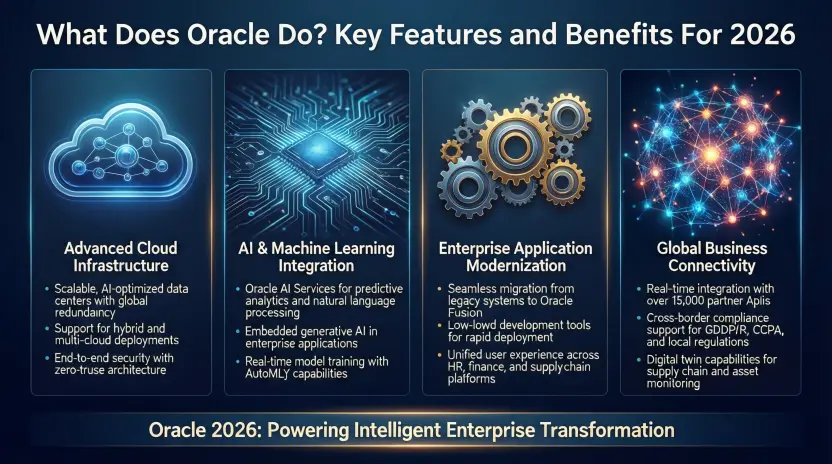
Oracle is one of the world’s leading technology companies, known for providing a wide range of products and services that power businesses across the globe.
From its beginnings as a database software provider, Oracle has grown into a comprehensive enterprise solutions company, offering cloud computing, enterprise resource planning (ERP), customer relationship management (CRM), hardware systems, and AI-driven tools.
Businesses of all sizes, across industries like finance, healthcare, retail, and government, rely on Oracle to manage data, streamline operations, and improve decision-making.
Understanding what Oracle does is crucial not only for IT professionals but also for business leaders seeking efficient software and cloud solutions.
This article explores Oracle’s history, its main products and services, the industries it serves, and how it generates revenue, providing a complete picture of one of the most influential tech companies in the world.
History and Background of Oracle
Oracle Corporation was founded in 1977 by Larry Ellison, Bob Miner, and Ed Oates under the original name Software Development Laboratories (SDL).
The company’s initial focus was on developing a relational database management system (RDBMS), which was revolutionary at the time. By 1979, the product evolved into Oracle Database, one of the first commercially available relational databases, setting the foundation for Oracle’s long-term success in enterprise software.
Throughout the 1980s and 1990s, Oracle expanded rapidly, introducing new software products and entering international markets. The company also became known for its aggressive acquisition strategy, acquiring smaller software companies to strengthen its portfolio. This expansion allowed Oracle to offer comprehensive enterprise solutions, including ERP, CRM, and middleware software.
In the 2000s, Oracle embraced the cloud computing revolution, launching Oracle Cloud services to provide infrastructure (IaaS), platforms (PaaS), and software as a service (SaaS) solutions to businesses worldwide. Today, Oracle is a global technology leader, serving thousands of clients in industries such as finance, healthcare, retail, and government. Understanding this history is essential to grasp how Oracle evolved from a simple database company to a multifaceted tech powerhouse.
Oracle’s Main Products and Services
Oracle is widely recognized for offering a diverse range of products and services that cater to businesses of all sizes.
At its core, Oracle provides database solutions, which remain the backbone of its offerings.
The Oracle Database is renowned for reliability, scalability,
and advanced features like autonomous management, making it a preferred choice for enterprises managing critical data.
Beyond databases, Oracle offers cloud services, which include Infrastructure as a Service (IaaS), Platform as a Service (PaaS), and Software as a Service (SaaS). These cloud solutions help companies reduce IT costs, improve efficiency, and scale their operations seamlessly.
In addition to databases and cloud, Oracle provides enterprise software solutions, including ERP (Enterprise Resource Planning), CRM (Customer Relationship Management), and HCM (Human Capital Management) applications. These tools assist organizations in streamlining business processes, improving customer relationships, and managing workforce resources effectively. Oracle also offers analytics and business intelligence software that empowers companies to make data-driven decisions and gain actionable insights.
Oracle doesn’t stop at software.
The company also produces hardware solutions like servers, storage systems, and engineered systems, which are tightly integrated with its software for optimized performance.
Furthermore, Oracle provides consulting and support services, helping businesses implement and maintain their Oracle solutions efficiently.
Altogether, Oracle’s main products and services form a comprehensive ecosystem designed to address nearly every enterprise IT need.
Oracle Database: The Core Offering
The Oracle Database is the foundation of Oracle’s business and remains one of the most widely used relational database management systems (RDBMS) in the world. First introduced in 1979, it revolutionized how businesses store, manage, and access data. Today, Oracle Database offers advanced features like autonomous management, high availability, scalability, and strong security, making it a top choice for enterprises handling large volumes of critical data.
Oracle provides several database types to meet different business needs.
The Oracle Autonomous Database uses machine learning to automate routine tasks such as patching, backups, and performance tuning, reducing the need for manual administration.
Traditional on-premises databases are still popular among large organizations that require direct control over their infrastructure.
Oracle also offers cloud-based databases, which provide flexible and scalable solutions for businesses moving toward digital transformation.
The Oracle Database is widely used across industries such as finance,
healthcare, retail, and government, powering applications that handle everything from transaction processing to analytics.
Its integration with Oracle Cloud and enterprise software solutions ensures seamless data management and business intelligence capabilities.
In addition, Oracle’s database ecosystem supports development frameworks, programming languages, and analytics tools, enabling companies to build customized applications and extract valuable insights from their data. By providing a reliable, secure, and intelligent database platform, Oracle helps organizations operate efficiently, innovate faster, and maintain a competitive edge in today’s data-driven world.
Oracle Cloud Services Explained
Cloud Services have become a cornerstone of the company’s offerings, providing businesses with flexible, scalable, and cost-effective cloud solutions.
includes Infrastructure as a Service (IaaS), Platform as a Service (PaaS), and Software as a Service (SaaS), allowing organizations to choose the right combination of services to meet their IT and business needs.
With Oracle Cloud, companies can host applications, store data, run analytics, and deploy enterprise software without the high costs and complexity of maintaining on-premises infrastructure.
IaaS provides computing power, storage, and networking resources in the cloud, enabling businesses to scale operations quickly. PaaS allows developers to build, test, and deploy applications efficiently, with access to tools like Oracle Autonomous Database, AI, and analytics platforms. SaaS solutions, including ERP, HCM, and CRM, give organizations ready-to-use software for managing finances, human resources, and customer relationships, all delivered via the cloud.
Oracle Cloud also emphasizes security, reliability, and high performance, offering advanced encryption, disaster recovery, and global data centers to ensure uninterrupted business operations. Compared to competitors like AWS and Microsoft Azure, Oracle Cloud is particularly strong in enterprise-focused applications and integration with existing Oracle databases and software.
By adopting Oracle Cloud, businesses can reduce IT costs, increase agility, and leverage cutting-edge technologies like artificial intelligence, machine learning, and analytics. Overall, Oracle Cloud Services provide a comprehensive, modern solution for enterprises aiming to transform digitally and maintain a competitive edge in their industries.
Oracle Software and ERP Solutions
Oracle is widely recognized for its robust software and enterprise solutions,
which help organizations streamline operations, manage resources, and improve decision-making. Among its most popular offerings are Enterprise Resource Planning (ERP), Customer Relationship Management (CRM), and Human Capital Management (HCM) solutions.
These applications are designed to integrate various business processes,
from finance and procurement to HR and customer engagement, providing a unified platform for enterprise operations.
Oracle ERP solutions enable companies to automate financial management, supply chain operations, and procurement processes. This reduces manual work, minimizes errors, and provides real-time visibility into key business metrics. The CRM software helps organizations manage customer interactions, track sales, and improve marketing campaigns, enhancing customer satisfaction and loyalty. Meanwhile, HCM solutions support workforce management, payroll, talent acquisition, and employee engagement, helping businesses maintain a productive and satisfied workforce.
In addition to ERP, CRM, and HCM, Oracle provides a wide range of analytics and business intelligence tools. These tools allow companies to analyze large datasets, identify trends, and make data-driven decisions. Many Oracle software solutions are now available via Oracle Cloud, making them scalable, secure, and accessible from anywhere.
By offering an integrated ecosystem of software solutions, Oracle enables businesses to optimize operations, reduce costs, and improve overall efficiency.
These ERP and enterprise tools are widely adopted across industries, including finance, healthcare, retail, and manufacturing,
solidifying Oracle’s role as a leading provider of enterprise software solutions worldwide.
Oracle Hardware and Infrastructure
While Oracle is best known for its software and cloud solutions,
the company also provides high-performance hardware and infrastructure products designed to complement its software ecosystem.
Oracle’s hardware offerings include servers, storage systems, engineered systems, and networking solutions, all optimized to run Oracle software efficiently. This integration ensures that businesses experience maximum performance, reliability, and scalability in their IT operations.
Oracle’s engineered systems,
such as the Oracle Exadata Database Machine, are pre-configured hardware-software bundles that simplify database deployment and improve processing speed.
These systems are particularly valuable for organizations managing large-scale data workloads, as they provide enhanced storage, faster query performance, and improved data security. Additionally, Oracle’s storage solutions, including cloud-connected storage arrays, enable businesses to manage and protect massive amounts of data effectively.
Networking and infrastructure solutions from Oracle support high availability and disaster recovery, ensuring that mission-critical applications remain operational even during hardware failures or unexpected disruptions. By tightly integrating hardware with Oracle software, businesses can reduce compatibility issues, simplify maintenance, and lower overall IT costs.
Oracle hardware and infrastructure solutions are widely used in industries that require robust data management and computing power, such as finance, healthcare, government, and telecommunications.
By offering both software and hardware, Oracle provides a complete enterprise ecosystem, allowing organizations to streamline operations, scale efficiently, and maintain high levels of performance and reliability.
Industries That Rely on Oracle
Oracle’s products and services serve a wide range of industries, making it one of the most influential technology providers in the world. Businesses across finance, healthcare, retail, government, manufacturing, and telecommunications rely on Oracle to manage their critical operations, store and analyze data, and support digital transformation initiatives.
In the finance industry, Oracle helps banks and financial institutions manage transactions, comply with regulations, and analyze customer behavior using its database, cloud, and analytics solutions. Healthcare organizations leverage Oracle’s cloud services, ERP, and HCM tools to streamline patient management, optimize hospital operations, and secure sensitive medical data.
The retail sector benefits from Oracle’s solutions by integrating inventory management, e-commerce platforms, and customer relationship tools to improve operational efficiency and enhance the shopping experience. In government, Oracle provides secure and reliable systems for managing public services, citizen records, and large-scale data infrastructure.
Manufacturing companies use Oracle ERP and supply chain management tools to optimize production, reduce costs, and improve resource planning. Similarly, telecommunication providers rely on Oracle’s databases, cloud, and analytics tools to manage networks, customer data, and billing systems.
Oracle’s versatility across industries is a result of its comprehensive ecosystem, which combines software, cloud, hardware, and consulting services. By providing tailored solutions for specific industry needs, Oracle empowers organizations to improve efficiency, reduce costs, and make data-driven decisions, reinforcing its position as a global technology leader.
How Oracle Makes Money
Oracle generates revenue through a combination of software sales, cloud services, hardware, and consulting solutions, making it a diversified technology company. The largest portion of Oracle’s income comes from its database software and licenses. Businesses purchase on-premises licenses or subscriptions to use Oracle Database, which powers critical applications and stores massive amounts of data. Oracle also earns from software updates, support services, and maintenance contracts, ensuring customers keep their systems running smoothly.
Cloud services have become an increasingly significant revenue stream.
Oracle offers Infrastructure as a Service (IaaS),
Platform as a Service (PaaS), and Software as a Service (SaaS), which are typically billed on a subscription basis. Organizations pay recurring fees to access Oracle’s cloud applications, storage, analytics tools, and AI-driven solutions. The shift from traditional licensing to cloud subscriptions has allowed Oracle to secure predictable, recurring revenue while expanding its market share in enterprise IT.
Oracle also sells hardware products, including servers, storage systems, and engineered systems that are tightly integrated with its software solutions.
These products are used in data centers and enterprise environments to optimize performance and reliability.
Additionally, consulting and professional services provide implementation, training, and support for Oracle’s software and cloud offerings, generating further revenue.
By combining software licensing, cloud subscriptions, hardware sales, and consulting services, Oracle has built a robust business model. This diversified approach ensures steady revenue growth, allows the company to adapt to technology trends, and strengthens its position as a leading provider of enterprise solutions worldwide.
The Future of Oracle: Trends and Innovations
Oracle continues to evolve as a technology leader, focusing on innovation and emerging trends that shape the future of enterprise IT. One of the key areas of growth is cloud computing. Oracle is expanding its cloud services to compete with industry giants like Amazon Web Services and Microsoft Azure, emphasizing autonomous databases, AI-driven applications, and integrated cloud infrastructure. Businesses are increasingly adopting Oracle Cloud to improve efficiency, reduce IT costs, and enable digital transformation.
Another major trend is artificial intelligence (AI) and machine learning. Oracle integrates AI into its software and cloud platforms to automate routine tasks, enhance analytics, and support predictive decision-making. For example, the Oracle Autonomous Database uses AI to optimize performance, manage security, and perform updates automatically, reducing manual intervention and human error.
Oracle is also investing in blockchain technology, data analytics, and edge computing to help businesses gain deeper insights and secure digital transactions.
These innovations are designed to support industries such as finance, healthcare, retail, and manufacturing, enabling them to respond faster to market changes and customer demands.
Furthermore, Oracle is prioritizing sustainability and efficiency in its operations and product design, aligning with global trends toward eco-friendly IT solutions. By continuously innovating and adapting to new technologies, Oracle positions itself as a forward-thinking enterprise solution provider, ensuring that its customers remain competitive in a rapidly changing digital landscape.
The company’s commitment to cloud expansion, AI integration, and emerging technologies indicates that Oracle will continue to play a central role in shaping the future of enterprise computing.
FAQs
When it comes to understanding Oracle, many people have common questions about its products, services, and role in the technology industry.
Here are some frequently asked questions:
1. What is Oracle best known for?
Oracle is best known for its database software,
which helps businesses manage and store large amounts of data.
Over the years, it has expanded into cloud computing, enterprise software, and hardware solutions, becoming a comprehensive technology provider.
2. Is Oracle only a database company?
No. While databases remain a core part of Oracle’s offerings, the company also provides cloud services, ERP, CRM, HCM software, analytics tools, and hardware solutions. These products form a complete ecosystem for enterprise IT needs.
3. How is Oracle Cloud different from competitors?
Oracle Cloud focuses on enterprise-specific solutions and integration with existing Oracle software, providing strong security, performance, and scalability. It also offers autonomous capabilities through AI and machine learning, which reduces manual management.
4. Can small businesses use Oracle solutions?
Yes. Oracle offers cloud-based solutions and subscription models that are scalable and affordable, making them accessible to both small and large enterprises.
5. How does Oracle support digital transformation?
Oracle enables organizations to move operations to the cloud, automate processes, analyze data, and improve customer experiences. Its integrated software and hardware ecosystem allows businesses to modernize IT infrastructure efficiently.
By addressing these questions, businesses and IT professionals can gain a clearer understanding of Oracle’s role, offerings, and value in today’s technology-driven world.
Conclusion
Oracle is more than just a database company, it is a global technology leader offering a comprehensive ecosystem of products and services that help businesses operate efficiently and innovate in a rapidly evolving digital landscape.
From its early days as a relational database provider to its current position as a cloud computing and enterprise software powerhouse, Oracle has continuously adapted to meet the needs of modern organizations.
The company’s offerings span databases, cloud services, ERP, CRM, HCM, analytics tools, hardware, and consulting services, providing solutions for a wide range of industries including finance, healthcare, retail, government, manufacturing, and telecommunications.
By integrating software with hardware and cloud infrastructure, Oracle delivers reliable, secure, and scalable solutions that empower businesses to streamline operations, improve decision-making, and maintain a competitive edge.
Oracle’s innovative initiatives, such as autonomous databases, AI-powered tools, and blockchain integration, demonstrate its commitment to the future of enterprise technology.
With a strong focus on cloud adoption, automation, and emerging technologies, Oracle is helping organizations transform digitally while reducing costs and increasing operational efficiency.
Understanding what Oracle does is essential for IT professionals, business leaders, and decision-makers seeking reliable enterprise solutions.
By leveraging Oracle’s extensive ecosystem, businesses can optimize processes, manage data effectively, and stay ahead in today’s technology-driven world.
Oracle’s combination of experience, innovation, and comprehensive solutions ensures it remains a trusted partner for enterprises across the globe.

Tina Tease — Mixing charm, humor, and a little playful mischief in every post. From flirty fun to smart, sassy captions, this page brings entertainment with attitude and personality. Powered by ThePunSide.com for daily laughs, clever moments, and irresistible tease-energy.