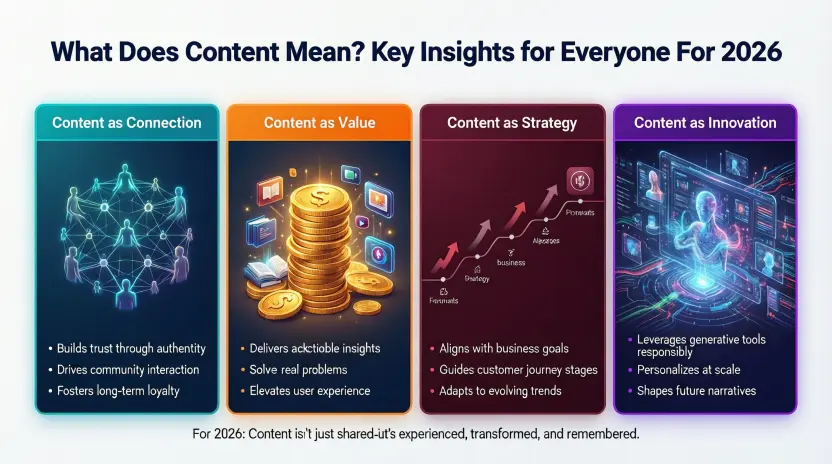
The word content is everywhere today.
You hear it in classrooms, on social media, in marketing, and across the internet, but many people still wonder: what does content mean exactly?
The confusion happens because content can have different meanings depending on how and where it is used.
Sometimes it refers to information in a book, sometimes to a social media post, and other times to videos, images, or articles online.
In simple terms, content is the information, material, or message that is created to inform, educate, or entertain people.
From a blog post you read, to a video you watch, or even a podcast you listen to, all of it is content.
In today’s digital world, content plays a huge role in communication, learning, and online visibility.
In this article, you’ll learn the true meaning of content, its different types, and how it is used in everyday life and online platforms.
What Is the Definition of Content?
The definition of content refers to the information, material, or substance that is contained within something. In general English, content means what is inside a book, document, container, or message. For example, the content of a book includes the text, ideas, and information written on its pages.
In a broader sense, content is anything that communicates a message to an audience. This message can be educational, informative, entertaining, or persuasive.
Content is not limited to words only. It can include images, videos, audio, graphics, or even interactive elements like quizzes and polls.
In modern usage, especially online, content usually refers to digital material created for people to consume.
This includes blog posts, social media updates, videos, podcasts, emails, and website pages. When people say “create content,” they mean producing material that provides value to others.
The key idea behind content is purpose. Content always exists for a reason, such as explaining something, sharing knowledge, telling a story, or promoting an idea.
Without meaning or value, information is not considered effective content.
So, if it is written in a textbook, posted on a website, or shared on social media, content is the core message being delivered.
Understanding this definition helps clear confusion and makes it easier to recognize content in both everyday life and the digital world.
What Does Content Mean in Simple Words?
In simple words, content means anything that carries information or a message. If something is created for people to read, watch, listen to, or learn from, it is content. This makes the idea of content very easy to understand when you think about everyday examples.
For instance, the words written in a notebook are content.
The photos on your phone are content. A video you watch on YouTube, a post you scroll past on social media, or even a voice note you listen to on your phone are all forms of content. Content is not about the platform itself, but about what is being shared through it.
Another easy way to understand content is to think of it as the message inside a container. The container could be a book, a website, an app, or a social media platform.
The content is what fills that container and gives it meaning. Without content, a platform would have nothing valuable to offer.
Content can be created by anyone. Students create content when they write assignments. Teachers create content when they prepare lessons. Businesses create content to explain their products. Even regular users create content when they post photos, comments, or videos online.
So, in the simplest terms, content is what you create and share to communicate with others. It can be educational, entertaining, or informative, but its main purpose is always to deliver a message people can understand and engage with.
What Does Content Mean in Education?
In education, content refers to the subject matter or information that is taught and learned. It includes the topics, lessons, facts, concepts, and skills that students study in schools, colleges, and training programs.
When teachers talk about course content, they are referring to what students are expected to understand and learn.
Educational content can be found in many forms. Textbooks contain written content such as explanations, examples, and exercises.
Teachers also create content in the form of lectures, presentations, worksheets, and lesson plans. In modern classrooms, digital content like online articles, videos, slides, and interactive quizzes is widely used to support learning.
The purpose of educational content is to inform, explain, and develop knowledge. Good content helps students understand complex ideas in a clear and structured way.
For example, a science lesson may include content about plants, animals, or the human body, while a history class focuses on events, dates, and important figures.
Educational content is not limited to traditional classrooms. Online courses, e-learning platforms, and educational apps all rely on well-organized content to teach users effectively. Even homework assignments and exam questions are considered part of educational content.
In simple terms, content in education is what is being taught, not how it is taught. The teaching method may change, but the content remains the core information students need to learn, understand, and apply in real life.
What Does Content Mean in Digital Marketing?
In digital marketing, content means the material businesses create and share online to attract, inform, and engage their audience.
This type of content is designed to provide value while also supporting marketing goals such as brand awareness, traffic, and conversions.
Marketing content appears in many forms. Blog posts explain topics in detail, social media posts connect brands with users, videos showcase products or tell stories, and emails deliver updates or offers directly to customers. All of these are considered content because they communicate a message to a specific audience.
The main purpose of content in digital marketing is to solve problems or answer questions people are already searching for.
For example, a business may create a blog article to explain how a product works or a video to demonstrate its benefits. Helpful content builds trust and positions a brand as an authority in its industry.
Search engines like Google also rely on content to rank websites.
High-quality, relevant content helps websites appear in search results when users look for information. This is why content is often called the backbone of digital marketing.
Unlike traditional advertising, digital content focuses more on value than direct selling. When content is informative, engaging, and useful, it naturally attracts users and encourages them to take action. In short, content in digital marketing is the bridge between businesses and their online audience, helping both sides connect in a meaningful way.
Types of Content Explained
Content comes in many forms, and each type serves a different purpose depending on how people prefer to consume information. Understanding the different types of content makes it easier to recognize how content is used across platforms and industries.
Written content is one of the most common forms. It includes blog posts, articles, website pages, emails, and ebooks. Written content is mainly used to explain topics in detail, share information, and improve search engine visibility.
Visual content focuses on images and graphics. Photos, infographics, charts, and illustrations fall into this category. Visual content helps simplify complex ideas and quickly capture attention, especially on social media and websites.
Video content has become extremely popular. Examples include YouTube videos, short-form reels, tutorials, vlogs, and live streams. Video content combines visuals and audio, making it engaging and easy to understand.
Audio content includes podcasts, audiobooks, and voice recordings. This type of content is ideal for people who prefer listening while multitasking, such as during travel or exercise.
Interactive content allows users to participate instead of just consuming information. Quizzes, polls, surveys, calculators, and interactive tools are examples. This type of content increases engagement and keeps users involved.
Each type of content has its own strengths, and many creators use a mix of formats to reach a wider audience. No matter the format, the goal of content remains the same: to communicate a message clearly and effectively.
What Does Content Mean on Social Media?
On social media, content refers to anything that users or brands post to share information, express ideas, or engage with others. This includes text posts, images, videos, stories, reels, captions, comments, and even live streams. Every piece of material shared on a social platform is considered content.
Social media content is usually created to entertain, inform, inspire, or connect with an audience. For example, a short video on TikTok may be designed to entertain, while an Instagram post might aim to inspire or promote a product. Facebook and LinkedIn content often focuses on sharing information, updates, or professional insights.
One important aspect of social media content is engagement. Likes, shares, comments, and saves show how people interact with content. The more engaging the content, the more likely it is to reach a larger audience through platform algorithms.
Social media content can be created by anyone. Regular users share personal photos or thoughts, while content creators and businesses produce professional posts to grow their audience or brand. This is why social media platforms are built around content creation and sharing.
Another key concept is user-generated content, which refers to content created by users rather than brands. Reviews, comments, tagged photos, and testimonials are examples. This type of content builds trust and authenticity.
In simple terms, content on social media is what fills your feed. It is the posts and media you scroll through every day, designed to communicate messages and spark interaction.
What Does Content Mean on a Website?
On a website, content refers to all the information and material presented to visitors. This includes text, images, videos, infographics, downloadable files, and interactive elements. Essentially, content is what makes a website meaningful and useful to its users.
Website content serves multiple purposes. It informs visitors about a business, organization, or topic, helps answer questions, and guides users toward actions such as subscribing, purchasing, or contacting. For example, a blog post on a website provides detailed information on a topic, while product pages showcase offerings with descriptions, images, and specifications.
Effective website content is well-organized, relevant, and valuable. It should clearly communicate the website’s purpose and meet the needs of its audience. This includes using headings, bullet points, visuals, and other elements to make information easy to read and understand.
Websites also rely on content for search engine optimization (SEO). Search engines analyze the content on a website to determine its relevance to users’ searches. High-quality content increases a website’s visibility and attracts more visitors.
Interactive content, such as forms, quizzes, or calculators, adds value and improves user engagement. Even elements like FAQs, tutorials, and guides are considered content because they deliver information to the audience.
In short, website content is everything a visitor sees, reads, or interacts with. It is the foundation of the website’s purpose and the primary way it communicates with its audience, educates users, and supports online goals.
What Does Content Mean in Media and Publishing?
In media and publishing, content refers to the information, stories, or messages delivered to an audience through different channels such as newspapers, magazines, television, radio, and online platforms. Content in this context is what captures attention, informs, entertains, or educates the public.
There are several types of media content. Editorial content includes news articles, opinion pieces, and feature stories. Its primary goal is to inform, educate, or provide commentary on current events. Promotional content, on the other hand, is created to advertise products, services, or events, often blending marketing with storytelling to engage audiences.
With the rise of digital media, content has expanded beyond traditional formats. Online publications, blogs, podcasts, and videos are now major forms of media content. Social media platforms also allow media companies to share content quickly and interactively, reaching a larger audience.
Content in media and publishing is also guided by quality and accuracy. Journalists and editors carefully research and fact-check information before publishing to maintain credibility. Similarly, authors and creators aim to produce engaging and valuable material for their readers or viewers.
In simple terms, content in media and publishing is everything you read, watch, or listen to that conveys a message or story. If it’s a newspaper article, a YouTube documentary, a radio interview, or a magazine feature, all of it is content created to connect with an audience and deliver value.
Why Is Content Important?
Content is important because it is the primary way people communicate, learn, and engage in both everyday life and the digital world. Without content, there would be no information to share, no stories to tell, and no ideas to explore. It is the foundation of communication, education, and marketing.
In education, content helps students understand complex concepts and acquire knowledge. Well-organized content in textbooks, lectures, or online courses ensures that learning is clear and effective. Without quality educational content, students would struggle to grasp important subjects.
In digital marketing and business, content is essential for attracting and retaining customers. High-quality blog posts, social media updates, videos, and emails provide value, build trust, and establish authority. Content allows businesses to explain their products, share expertise, and connect with their audience in meaningful ways.
Content is also crucial for search engines. Websites with valuable, well-structured content rank higher in search results, helping more people find information and services. This is why content is often referred to as the backbone of SEO and online visibility.
Moreover, content is key to engagement. Interactive content like polls, quizzes, and videos encourages users to participate, share, and respond, creating a two-way conversation. If educational, informative, entertaining, or persuasive, content shapes how people perceive and interact with information.
In short, content is important because it delivers value, communicates messages, and builds connections across all areas of life and online platforms.
Content vs Information: What’s the Difference?
Although the words content and information are often used interchangeably, they have distinct meanings. Understanding the difference helps clarify how we communicate, create, and consume material effectively.
Information refers to facts, data, or knowledge that someone can use or learn from. For example, a statistic about population, a fact about history, or instructions for assembling furniture are all information. Information is raw and can exist on its own without much context or presentation.
Content, on the other hand, is information packaged and presented for an audience in a meaningful way. It includes the medium, format, and purpose behind the information. A blog post explaining that statistic, a history article telling a story, or a video tutorial showing how to assemble furniture transforms information into content. Content is always created to inform, entertain, or engage an audience.
The main difference is that information is the what, while content is the how it is delivered. Information can exist without being content, but content cannot exist without information. For example, a raw dataset is information, but an infographic summarizing that dataset is content.
Understanding this difference is crucial in education, media, marketing, and digital platforms. Content makes information accessible, appealing, and useful to the audience, turning facts or data into something people can read, watch, listen to, or interact with.
In simple terms, information tells, content communicates.
Content vs Data vs Media
While the terms content, data, and media are sometimes used interchangeably, they refer to different concepts. Understanding the distinction helps clarify how information is created, shared, and consumed.
Data refers to raw facts, figures, or statistics. It is unprocessed and usually lacks context or meaning on its own. For example, a list of website visits, temperatures, or sales numbers is considered data. Data alone doesn’t communicate a message until it is analyzed or interpreted.
Content is information organized and presented for an audience. It transforms raw data or facts into something meaningful, such as articles, videos, blogs, or podcasts. For instance, a blog post analyzing sales trends using graphs and explanations is content because it communicates the information in a way that people can understand and engage with.
Media refers to the channels or platforms through which content is delivered. Examples include television, radio, social media, websites, newspapers, and podcasts. Media is the vessel that carries content to an audience. For instance, a video uploaded to YouTube is both content (the video itself) and media (the platform hosting it).
The relationship between the three can be summarized as: data forms the foundation, content organizes and explains it, and media delivers it. Each plays a unique role, but content is the central piece that connects data with audiences through media.
In short, while data is raw, media is the vehicle, and content is the message that makes the data useful, engaging, and meaningful.
Examples of Content in Real Life
Content surrounds us every day, even if we don’t always notice it. In real life, content is anything created to communicate a message, share information, or provide entertainment. Recognizing these examples makes it easier to understand how content impacts our daily lives.
Written content appears everywhere. Textbooks, newspapers, emails, letters, and blog posts all contain written material designed to inform or engage readers. Even a note left on a fridge or a recipe card is content because it communicates information to someone.
Visual content is equally common. Photos, posters, advertisements, infographics, and illustrations are all forms of visual content. These images often convey messages quickly and can be easier to understand than written content alone.
Audio content includes things like podcasts, radio shows, audiobooks, and voice notes. People listen to this type of content while commuting, exercising, or relaxing at home. It allows messages to reach audiences who prefer listening over reading.
Video content combines visual and audio elements. Movies, TV shows, YouTube videos, live streams, and online tutorials are all video content. Videos often explain complex topics in a simple, engaging way.
Interactive content can be found in quizzes, surveys, online polls, and games. This type of content encourages participation and keeps audiences engaged.
Even daily conversations, social media posts, and advertisements are forms of content. Essentially, any message created to communicate, educate, or entertain counts as content. Understanding these examples helps us see how content shapes knowledge, entertainment, and communication in everyday life.
Common Misunderstandings About Content
Despite being a widely used term, many people have misunderstandings about what content actually is. Clarifying these common misconceptions helps in creating, consuming, and appreciating content more effectively.
One common misunderstanding is that content is only digital. While online content like blogs, social media posts, and videos is very visible, content exists offline too. Books, newspapers, posters, flyers, radio broadcasts, and even handwritten notes are all content because they communicate messages.
Another misconception is that content is only text. In reality, content can be visual, audio, interactive, or a combination of formats. Photos, videos, infographics, podcasts, and games are all content. Thinking that content is just written material limits creativity and understanding.
Some people also believe that creating content requires professional skills. While professional content often has higher quality, anyone can create content. Students writing essays, friends posting photos on social media, or small businesses sharing updates are all producing content. The key is the purpose of communication, not perfection.
Another misunderstanding is that all content must go viral or be widely shared. Content can be valuable even if it reaches a small audience. Its purpose is to communicate a message, educate, entertain, or engage, regardless of size.
By understanding these points, it becomes clear that content is any meaningful message or material created for an audience, not restricted to digital platforms, text, or professional production. Recognizing this helps people create and use content more effectively in daily life.
How Content Is Created
Creating content involves a thoughtful process to ensure the message is clear, engaging, and valuable to the audience. If it’s for education, marketing, or entertainment, content creation follows several key steps.
The first step is planning and research. Before creating content, it’s important to understand the audience, purpose, and topic. This involves identifying what the audience needs, what questions they have, and what format will be most effective. Research ensures that the content is accurate, relevant, and useful.
Next is the creation phase, where the actual content is produced. This could mean writing an article, designing a graphic, recording a video, or developing an interactive tool. During this stage, creators focus on presenting the information clearly and making it engaging.
After creation comes editing and refining. This step ensures the content is polished, free of errors, and aligned with its purpose. Editing may involve checking facts, improving readability, adjusting visuals, or enhancing audio quality.
The final step is publishing and sharing. Content is delivered through appropriate channels, such as websites, social media, email, or print media. Publishing also involves making the content accessible, properly formatted, and optimized for the platform it appears on.
Some creators also track performance and engagement to learn what works and improve future content. This feedback loop helps make content more effective over time.
In essence, content creation is a structured process that combines planning, production, refinement, and sharing. It ensures that the content communicates a clear message, reaches the right audience, and fulfills its intended purpose.
Future of Content in the Digital World
The future of content is closely tied to technology, digital platforms, and evolving audience expectations. As the way we consume information changes, content is becoming more interactive, personalized, and dynamic.
One major trend is the growth of AI-generated content. Artificial intelligence can now assist in creating written articles, videos, images, and even interactive media. This allows creators and businesses to produce content faster and scale their efforts while maintaining relevance to their audience.
Personalization is also shaping the future of content. Platforms and websites increasingly use data to tailor content to individual preferences. For example, streaming services recommend shows based on viewing history, and websites suggest articles based on user interests. Personalized content keeps audiences engaged and increases value for both users and creators.
Interactive and immersive content is gaining popularity. Virtual reality (VR), augmented reality (AR), and interactive tools allow audiences to engage with content in new ways. Instead of passively consuming, users can explore, participate, and experience content firsthand.
Another important aspect is cross-platform content. Audiences now consume content across social media, websites, apps, and devices. Creators must design content that is adaptable and effective across multiple formats.
Finally, content will continue to be value-driven. Audiences expect informative, entertaining, or useful content rather than just advertisements. Quality, relevance, and engagement will remain key.
In summary, the future of content is digital, interactive, personalized, and technology-driven, offering endless opportunities for creators to connect with audiences in meaningful and innovative ways.
Frequently Asked Questions About Content
Understanding content fully often involves answering common questions. Here are some of the most frequently asked questions about content:
1. What is the content of one sentence?
Content is any material or information created to communicate a message, educate, entertain, or engage an audience.
2. Is content the same as a post?
Not exactly. A post is one form of content, but content can also be videos, podcasts, infographics, articles, or interactive tools. Essentially, a post is a container, while content is the message inside it.
3. What does quality content mean?
Quality content is material that is accurate, engaging, relevant, and valuable to the audience. It communicates a clear message, provides useful information, and encourages interaction or understanding.
4. What is digital content?
Digital content is any content that exists in electronic form and is shared online. Examples include blog posts, social media updates, videos, podcasts, infographics, and websites.
5. Can anyone create content?
Yes. Anyone can create content. Students, teachers, businesses, or social media users all create content. The key is purpose sharing information, telling a story, or engaging an audience.
6. Why is content important online?
Online content helps websites rank in search engines, attracts audiences, builds trust, and provides valuable information. It is essential for communication, marketing, and engagement in the digital world.
By answering these questions, it becomes clear that content is versatile, meaningful, and essential in both everyday life and the digital world.
Conclusion
In today’s world, understanding what content means is more important than ever.
Content is not just text or posts; it is any material created to communicate a message, educate, entertain, or engage an audience.
From textbooks and social media updates to podcasts and videos, content surrounds us in every part of our daily lives.
Throughout this article, we explored the many dimensions of content. In education, content is the information students need to learn.
In digital marketing, it is the material businesses use to connect with and engage their audience.
On social media and websites, content is what attracts attention and provides value.
We also discussed the difference between content, information, and data, highlighting how content organizes information and delivers it meaningfully.
Understanding content also involves recognizing its types: written, visual, audio, video, and interactive. Each type serves a specific purpose and helps reach audiences in different ways.
Moreover, content creation follows a process that ensures messages are clear, relevant, and effective. Looking to the future, content will become more personalized, interactive, and technology-driven, offering exciting opportunities for creators and audiences alike.
In essence, content is the core of communication and information. It shapes learning, marketing, entertainment, and daily interactions.
By understanding its meaning and significance, anyone can create, share, and engage with content more effectively.
If you are a student, creator, business, or casual user, content is the bridge connecting ideas with people in meaningful ways.

“Hi, I’m Gigi Giggles! Spreading laughter and good vibes wherever .I go Lover of silly jokes, random adventures, and all things fun. Life’s too short to be serious, so let’s giggle, smile, and make every day a little brighter .Check out more puns and laughs at thepunside.com!