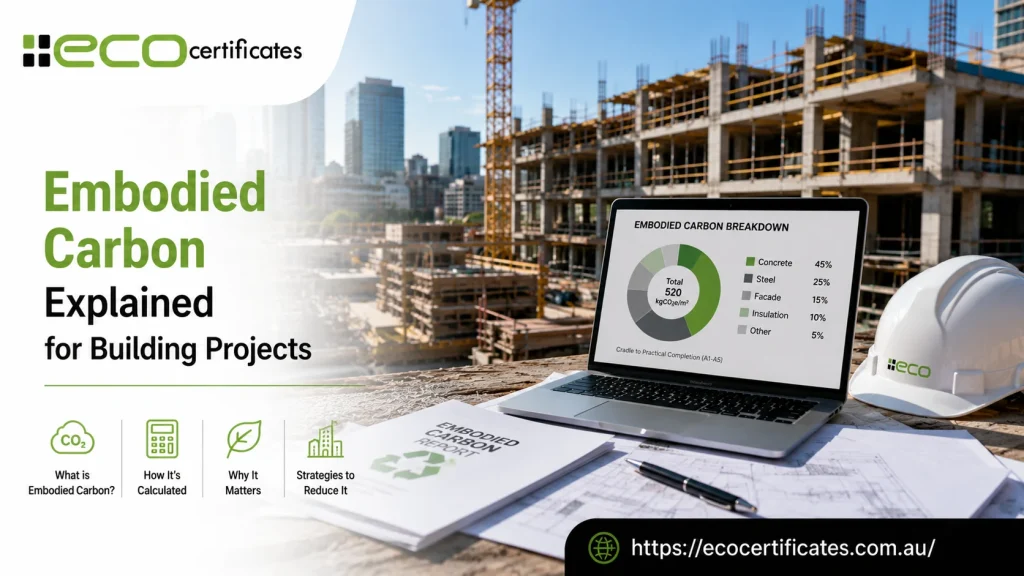
Every building carries a hidden carbon cost long before anyone switches on a light. That cost is called embodied carbon, and it comes from making, moving, and installing the materials your building is made of. It is now a core part of any ESD Report, so understanding it early is the difference between a genuinely sustainable build and a wasted opportunity.
This guide breaks down what embodied carbon is, why it matters, and how you can reduce it. If you want your project to meet modern sustainability standards, this is where to start.
What Is Embodied Carbon?
Embodied carbon is the total greenhouse gas emissions produced across a material’s entire life. It covers mining, manufacturing, transport, installation, and eventual disposal.
Concrete and steel are the biggest culprits, since both are made in enormous quantities. Producing just one ton of cement generates around 1.25 tons of CO2, largely from the chemical reaction in the kiln. This is why a building’s carbon footprint is set long before it is ever occupied. The choices made on the drawing board lock in most of these emissions.
Why Does Embodied Carbon Matter So Much?
Buildings account for a large share of global emissions, and materials are a growing part of that. The construction sector is responsible for roughly 37% of global energy-related emissions, with about 11% coming from materials and construction alone.
That share is climbing as buildings become more energy-efficient. In a high-performance building designed to net-zero operating standards, embodied carbon can account for 50% to 80% of total lifecycle emissions. The reason is simple. As operational emissions decline, the fixed carbon in the materials becomes the dominant contributor to the footprint.
Timing makes this urgent. Embodied carbon is released upfront during construction, so you cannot fix it later. An Embodied Emission Report measures this impact early, while you can still act on it.
How Is Embodied Carbon Measured?
You measure embodied carbon by adding up the emissions of every major material in your design. This is done through a life cycle assessment.
The process draws on Environmental Product Declarations, which give verified emissions data for specific products. A reliable Embodied Emission Report uses this product-level data rather than broad averages. The more accurate your inputs, the more useful the result becomes for cutting emissions.
Assessors focus on the highest-impact materials first, since these drive most of the total:
- Concrete and cement
- Structural steel
- Aluminium
- Glass and cladding
Getting these right delivers the biggest reductions for the least effort.
What Is the Data Centre Problem?
Data centres show exactly why embodied carbon deserves attention. They are built from vast quantities of concrete and steel, the two most carbon-intensive materials.
Their footprint is also growing fast. Data centres could reach as much as 8% of global emissions by 2030, driven largely by the rapid expansion of AI. While much attention goes to the power they consume, the embodied carbon in data centres is significant in its own right. The concrete shell alone represents thousands of tonnes of CO2 before a single server runs.
This makes early planning essential for any large infrastructure project. The material decisions set the carbon baseline for decades.
How Can You Reduce Embodied Carbon?
You reduce embodied carbon through smart material choices made early in design. Waiting until construction is too late, because the emissions are already committed.
Several proven strategies make a real difference:
- Use lower-carbon concrete. New mixes cut emissions without sacrificing strength.
- Consider mass timber. It can reduce embodied carbon by 22% to 50% and even store carbon.
- Reuse existing structures. Keeping a frame avoids the carbon of building a new one.
- Source materials locally. Shorter transport means lower emissions.
- Specify recycled content. Recycled steel and aggregate carry a smaller footprint.
A strong decarbonisation strategy weaves these choices into the design from day one. Small decisions, made early, add up to major savings across the whole project.
Why Start Early?
Early action is the whole game with embodied carbon. The emissions are fixed the moment materials are produced and installed.
An assessment during the design stage lets you compare options while changes are still cheap. Once the concrete is poured, the carbon is locked in for good. This is why reducing construction emissions depends entirely on decisions made before the build begins. The earlier you assess, the more you can cut.
Starting early also protects your budget. Lower-carbon choices made on paper cost far less than redesigns made on site.
How Does This Fit Broader Sustainability Goals?
Embodied carbon is central to genuine environmental progress in construction. You cannot claim a truly green building while ignoring the carbon in its bones.
Governments and standards increasingly require this data, so measuring it keeps your project compliant and future-ready. Building sustainable infrastructure means accounting for materials as seriously as energy use. A project that tackles both is one built to last, environmentally and commercially.
Build With the Full Picture in Mind
Embodied carbon shapes the true footprint of any building, and it is fixed the moment you build. Understanding it, measuring it early, and choosing lower-carbon materials are the keys to a genuinely sustainable project. The sooner you assess, the more impact you can have.
If you are planning a build and want to get this right, expert guidance removes the guesswork. Speak with the accredited team at Eco Certificates to measure your embodied carbon and fold it into a complete ESD Report from the very start.
Frequently Asked Questions
What is the difference between embodied and operational carbon?
Embodied carbon comes from the production and installation of materials. Operational carbon is generated by a building’s operations, such as heating, cooling, and lighting.
Which materials have the highest embodied carbon?
Concrete, steel, and aluminium are the biggest contributors. They are produced in large quantities and require energy-intensive manufacturing processes.
Can you reduce embodied carbon after construction?
No. The emissions are locked in once materials are produced and installed. This is why early design decisions matter so much.
Why is embodied carbon becoming more important?
As buildings become more energy-efficient, the fixed carbon in their materials becomes the largest share of their total lifecycle emissions.