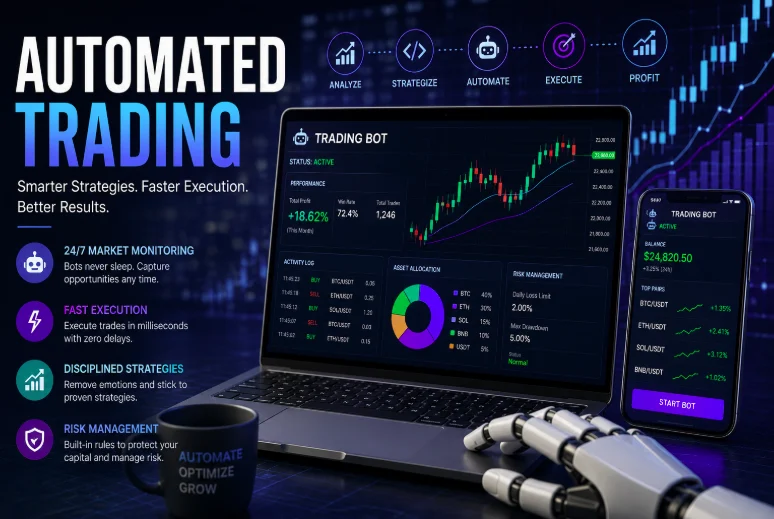
Financial markets have experienced significant technological evolution over the past two decades. From electronic exchanges and algorithmic systems to artificial intelligence and machine learning, technology continues to reshape how investors interact with global markets. Among these innovations, automated trading has emerged as one of the most influential developments, helping traders execute strategies with greater speed, consistency, and efficiency.
As markets become increasingly data-driven, many investors are turning to automation to reduce emotional decision-making and improve operational efficiency. Whether used by individual traders or large financial institutions, automated systems have become an integral part of modern trading environments.
Today, traders across stocks, forex, cryptocurrencies, and commodities are leveraging automation to identify opportunities, manage risk, and execute trades according to predefined rules.
Understanding Automated Trading
At its core, automated trading refers to the use of software programs that execute trades based on predetermined conditions. Instead of manually monitoring charts and entering orders, traders can create strategies that automatically respond to market movements.
These systems operate using specific criteria such as:
- Technical indicators
- Price movements
- Volume changes
- Market trends
- Risk management parameters
- Custom trading rules
When market conditions match the defined criteria, the software can execute trades automatically without requiring manual intervention.
This approach allows traders to maintain discipline and consistency while reducing the impact of emotional decision-making.
Why Automation Has Become So Popular
Modern financial markets operate around the clock, especially within cryptocurrency markets where trading never stops. Monitoring multiple assets continuously can be challenging for individual traders.
Automation addresses this challenge by enabling systems to monitor markets continuously and react instantly when opportunities arise.
Several factors have contributed to the growing popularity of automated solutions:
Speed of Execution
Market opportunities can appear and disappear within seconds. Automated systems can react much faster than human traders, helping to minimize delays between signal generation and trade execution.
Consistency
Human emotions often influence trading decisions. Fear, greed, and hesitation can lead to inconsistent execution. Automated strategies follow predefined rules regardless of market sentiment.
Scalability
Automation allows traders to monitor multiple assets and strategies simultaneously, something that would be difficult to accomplish manually.
Time Efficiency
Rather than spending hours watching charts, traders can focus on strategy development, research, and performance evaluation.
These advantages have made automation increasingly attractive to both retail and institutional market participants.
The Role of Trading Bots in Modern Markets
Trading bots have become one of the most recognized tools within automated trading ecosystems. These systems analyze market data and execute trades according to programmed instructions.
Modern trading bots can perform various functions, including:
- Trend-following strategies
- Breakout detection
- Arbitrage opportunities
- Portfolio rebalancing
- Risk management automation
- Technical indicator-based execution
As technology continues to improve, many trading platforms now offer user-friendly automation tools that require little or no coding experience.
For traders seeking to streamline their workflow, solutions like Automated Trading platforms provide accessible ways to create, test, and deploy trading strategies across different market environments.
Reducing Emotional Trading Decisions
One of the most challenging aspects of investing is managing emotions. Markets can trigger strong psychological responses that often lead to poor decision-making.
Common emotional trading mistakes include:
- Panic selling during market declines
- Chasing momentum after large price increases
- Ignoring stop-loss levels
- Overtrading after losses
- Taking excessive risks during winning streaks
Automation helps address these issues by enforcing predefined trading rules.
When a strategy is properly designed, the system executes trades based on objective criteria rather than emotional reactions. This consistency can help traders maintain discipline, particularly during volatile market conditions.
Risk Management Remains Essential
While automation offers numerous advantages, it does not eliminate risk. Markets remain unpredictable, and no strategy can guarantee profitability.
Successful traders understand that automation should complement sound risk management practices rather than replace them.
Important risk management principles include:
Position Sizing
Limiting exposure on individual trades helps reduce the impact of potential losses.
Stop-Loss Orders
Automated stop-loss mechanisms can help protect capital during adverse market movements.
Strategy Testing
Backtesting allows traders to evaluate historical performance before deploying a strategy in live markets.
Continuous Monitoring
Even automated systems require oversight to ensure strategies remain aligned with current market conditions.
Automation can improve execution efficiency, but risk management remains the foundation of sustainable trading success.
The Importance of Strategy Development
The effectiveness of an automated system depends largely on the quality of the underlying strategy.
A poorly designed strategy will not become profitable simply because it is automated. Instead, automation magnifies the strengths and weaknesses of the trading logic being used.
Successful strategy development often includes:
- Defining clear entry criteria
- Establishing exit conditions
- Implementing risk controls
- Testing across different market environments
- Evaluating performance metrics
Many traders spend significant time refining strategies before deploying them in live markets.
Automation should be viewed as a tool for executing a proven process rather than a shortcut to profitability.
Artificial Intelligence and the Future of Automation
Artificial intelligence is beginning to play an increasingly important role in automated trading systems.
Advanced technologies can assist with:
- Pattern recognition
- Market forecasting
- Sentiment analysis
- Data processing
- Adaptive strategy optimization
Machine learning models can analyze enormous datasets and identify relationships that may not be immediately visible through traditional analysis methods.
While AI-driven trading remains an evolving field, its integration into financial markets is expected to continue growing over the coming years.
As computational power increases and analytical tools become more sophisticated, traders may gain access to increasingly advanced automation capabilities.
Choosing the Right Trading Solution
With the growing popularity of automated systems, traders now have access to a wide range of platforms and tools.
When evaluating a solution, several factors should be considered:
Ease of Use
User-friendly interfaces help reduce complexity, particularly for beginners.
Strategy Flexibility
The ability to customize trading rules can improve adaptability across different market conditions.
Reliability
System stability and execution accuracy are essential for long-term performance.
Security
Protecting trading accounts and sensitive information should always be a priority.
Performance Analytics
Detailed reporting tools help traders evaluate results and refine strategies over time.
Platforms focused on Automated Trading often provide features that support both novice and experienced traders, making automation more accessible than ever before.
The Growing Adoption of Automated Systems
The use of automation is no longer limited to large financial institutions. Retail traders increasingly utilize automated tools to improve efficiency and compete in rapidly changing markets.
Several factors are driving broader adoption:
- Increased market accessibility
- Advances in cloud computing
- Improved software platforms
- Greater educational resources
- Rising interest in algorithmic investing
As technology becomes more affordable and user-friendly, automation is likely to become a standard component of many trading strategies.
The shift toward data-driven decision-making is creating new opportunities for traders who are willing to embrace technological innovation.
Conclusion
Automated trading has fundamentally changed how market participants interact with financial markets. By combining technology, strategy, and disciplined execution, automation enables traders to operate more efficiently while reducing the influence of emotions on decision-making.
Although automation does not eliminate market risk, it can improve consistency, scalability, and execution speed when used responsibly. Success ultimately depends on sound strategy development, effective risk management, and ongoing evaluation.
As financial technology continues to evolve, automated systems will likely play an even greater role in shaping the future of investing and trading. For traders seeking to enhance efficiency and maintain discipline in increasingly complex markets, automation represents a powerful tool with significant long-term potential.