Introduction
Going from an innovative design to a real product gives headaches to engineers and procurement managers all the time. Issues pop up – sheet metal costs too much, deliveries are late, or things work fine in small batches but crash during big productions because of fits and performances.
These issues mostly happen because people overlook material traits, manufacturing limits, and not preparing for DFM early on. Comparing service quotes without checking the actual mechanics usually results in pricey fixes later and takes a huge risk on the whole project.
Here, I’m gonna break down how to evaluate these services better. By diving into the five main factors affecting quality, price, and waiting time for custom parts, we’ll get a handle on picking the best services out there and moving projects forward smoothly.
How to Select the Most Suitable Sheet Metal Material and Process Combination for Your Project?
Choosing the most suitable combination of materials and production methods is essentially a matter of determining the right compromise between the product’s features, the cost, and the manufacturing simplicity. For instance, stainless steel is among the materials that promise you great strength and excellent resistance to corrosion, but they are still more expensive and difficult to work with.
Conversely, aluminum alloys make a great choice for the manufacture of the enclosures and other lightweight parts since they are not only easy to handle but also resistant to oxidation. Besides, we have the galvanized steel like SECC; it is very cheap and a very good choice for the protective cases. A lot, your decision will determine the main aspects such as the degree of heaviness attractiveness durability, weight, and which environment it is most suitable .
Understanding Core Sheet Metal Processes
- Process-Specific Applications
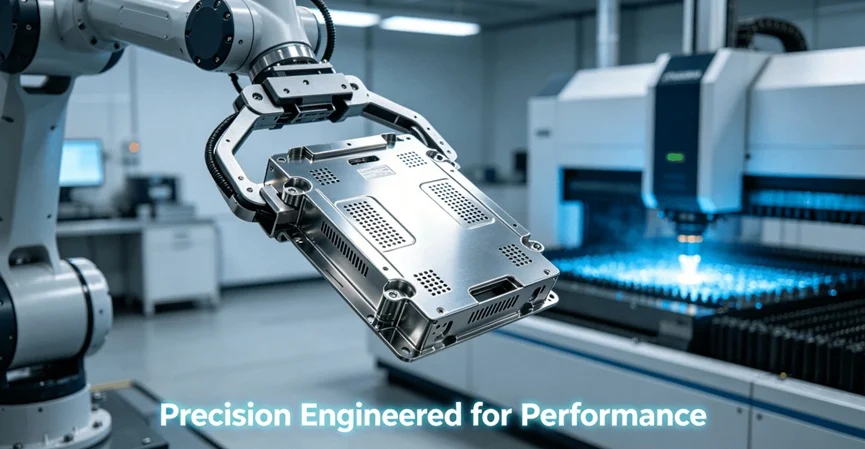
Key sheet metal fabrication processes serve distinct functions. Laser cutting handles intricate contours efficiently. CNC bending creates the final 3D form. Stamping is economical for high-volume punching, while welding assembles components. Complex parts require a combined process flow.
- The Need for a Combined Approach
A single process is rarely sufficient. Most functional parts result from a carefully orchestrated combination of these techniques, moving from cutting and bending to joining and finishing.
Matching Process to Product Need
There is no universal “best” solution. The optimal combination for a premium electronics enclosure differs vastly from that for a heavy-duty equipment bracket. Professional custom sheet metal fabrication services add value by recommending and executing the most suitable solution based on a deep understanding of all project needs. This consultative approach defines true precision metal fabrication services.
Which Design Details Determine the Mass Production Feasibility and Cost of Sheet Metal Parts?
Decisions made during the design phase effectively “lock in” over 80% of a part’s ultimate manufacturing cost and feasibility. Successful sheet metal fabrication for precision parts begins with rigorous adherence to Design for Manufacturability (DFM) rules.
The High Cost of Poor Design Parameters
- Common Design Pitfalls
Certain design details critically impact manufacturability. A bend radius under the material minimum causes cracking. Features like holes placed too near an edge or bend line can induce deformation, and undersized flanges may require non-standard tooling.
- Resulting Impact on Production
These oversights directly increase processing difficulty and scrap rates. They often necessitate costly, time-consuming adjustments or even custom tooling, dramatically inflating project costs and delaying timelines.
The Philosophy of Proactive DFM Optimization
Intentional design optimization gives big benefits too. By standardizing thicknesses, bends, and radii, we reduce machine setup time and increase line efficiency. Also, including proper allowances for welding and finishing helps ensure precise final assembly. Expert precision sheet metal fabrication services promote this collaborative approach to make sure designs are perfect for efficient mass production.
How Does Precision Sheet Metal Fabrication Guarantee ±0.1mm Dimensional Tolerances and Consistency?
To really excel in precision sheet metal fabrication, you need to hit tolerances of ±0.1mm or better. How do companies pull this off? It all hinges on three things: top-notch equipment, smart software, and a strict Quality Management System.
The machines are key. Super-powered CNC fiber laser cutters give you those perfect, smooth cuts every time. Also, CNC press brakes with fancy angle sensors and real-time fix systems make sure each bend is spot-on, even when materials try to warp. Without this advanced gear, such tight precision wouldn’t be possible.
Transforming that potential into reliable output calls for a comprehensive Quality Management System (QMS). Traceable sheet metal fabrication services implement stringent process controls such as comprehensive First Article Inspections (FAI) and copious documentation. They even conduct random audits in-process and end with a final inspection report for each lot. This forms a closed-loop quality system. Besides using calipers and height gauges, they also use sophisticated equipment like Coordinate Measuring Machines (CMMs) to obtain precise measurements and record data on critical dimensions. This not only allows them to detect any deviations swiftly but also to rectify them immediately.It’s important to choose a partner that spends on both tech and strong quality processes. If you want to know what that looks like, check out the standards set by qualified precision sheet metal fabrication services providers.
How to Achieve a Seamless Transition from Prototype to Mass Production While Controlling Costs?
Transitioning from a prototype to Mass Production Manufacturing is key for moving from validation to actual use and keeping costs in check. Prototypes focus on quick testing, which can be pricey per item since it uses general equipment and software. In contrast, mass production locks in peak efficiency and uniformity with specific tools, smart processes, and regular checks.
A good start is nailing down the prototype part. Getting help from a custom metal fabrication services provider lets you test both the product and the production methods early on. This helps spot and fix quality issues, making the whole ramp-up go smoother.
In mass production, economies of scale kick in. Skilled providers of sheet metal forming services boost efficiency and cut time by optimizing processes—combining steps and designing better dies. As a result, the cost structure changes: investments in hard tooling become fixed costs, while processing and overhead costs per unit drop with increased volume. An expert partner can figure out the best batch sizes and economic order quantities too, smoothing out the cost curve. They do this through refined processes and smarter production planning, which ensures the lowest total costs without skimping on quality.
Why are Certifications and Quality Control Systems Core Criteria for Selecting a Sheet Metal Supplier?
When you’re picking a sheet metal supplier, don’t just see international certifications like ISO 9001, IATF 16949, or AS9100D as simple pieces of paper. They’re actually proof that the company runs smoothly and consistently. An ISO Certified Manufacturing supplier is organized from beginning to end – orders get reviewed properly, materials are sourced correctly, and the finished products are delivered accurately and tracked efficiently.
The big perk of these standards is they focus on prevention and keeping things consistent. Since everything is documented and controlled, all the tasks are done based on established processes. If something does not work out, it will be a piece of cake to figure out the cause, solve it, and eliminate similar problems in the future. For highly-regulated industries such as automotive, medical, or aerospace, it is not a matter of whether to select a supplier with the proper certificates but only a way to prevent risks and guarantee superior quality.
A supplier with solid certification and quality control goes beyond just offering sheet metal fabrication services. They guarantee predictable deliveries, which cuts down on clients’ hidden management costs from quality checks, inspections, and supply coordination. Looking at how providers emphasize systematic construction shows how these processes support the reliability of the final product.
Conclusion
For a custom sheet metal fabrication project to succeed, precision engineering, design for manufacturability, and tight supply chain management are key. From material selection to refining designs and doing quality control, every choice matters. It shapes the final product’s quality, price, and timeline.
If you’re planning such a project, show your design to an experienced supplier with the best certifications. They help with the technical details and costs. Plus, getting their input early on makes sure your design works before moving forward.
Author Bio
A manufacturing and supply chain expert with over ten years of experience wrote this. They connect cutting-edge design with effective production. Dedicated to offering hardware teams real industrial fixes, the author uses industry-leading methods. Their advice is backed by what manufacturers like LS Manufacturing can actually do.
FAQs
Q1: What is the typical lead time for custom sheet metal fabrication?
A:Lead time relies on how complex the design is, the quantity needed, and the processes involved. Simpler parts can ship in 5-7 days, but more complex projects could take 3-6 weeks. Talking in detail with your supplier will give you the best scheduling info .
Q2: How do I get a quote for sheet metal fabrication? What files are needed?
A: For clear, quicker, and more precise quotes, please include detailed 2D drawings with specs on material, thickness, finish, and tolerances, or send 3D models like STEP files. This helps us give you Design for Manufacturability feedback too.
Q3: What are common surface finishing options in sheet metal fabrication?
A: Powder coating, which is a durable and attractive finish, is just one of the commonly used options. Another one is plating, such as zinc or chrome, which increases the resistance of a piece to corrosion. Besides wear resistance and color, anodizing also enhances the properties of the aluminum. Brushing or polishing can be thought of as giving the metal its finishing touches. Ultimately, the factors that impact your decision will be what matters to you most.
Q4: What are the main cost differences between low-volume custom and high-volume production?
A: With low-volume runs, the average cost of each item will be higher because the expenses for setting up, programming, and calibrating the machinery must be distributed over a smaller number of items. But, high-volume production lowers the cost per item through the use of optimized processes and specialized tools, although it entails a considerable initial investment in tooling. When deciding, take into account the total market .
Q5: Why is choosing a manufacturer with certifications like ISO 9001 important?
A:These certifications show the manufacturer follows a standardized quality management system for making parts that meet the requirements consistently. They reduce the risk of quality issues and delivery problems too. This serves as key proof of the supplier’s reliability and process capability, so it’s really important.