If you’re new to sports betting, chances are you’ve seen the term “spread” and thought, “What does that even mean? You’re not alone.
The point spread is one of the most common and most confusing concepts in sports betting, especially for beginners.
At first glance, those plus and minus numbers next to team names can feel intimidating, but once you understand them, spread betting becomes much easier to follow.
In simple terms, the spread is a way sportsbooks level the playing field between two uneven teams.
Instead of just picking who will win, you’re betting on how much a team will win or lose by. This makes games more competitive and creates more interesting betting opportunities.
In this guide, you’ll learn exactly what the spread means in betting, how it works in real games, and why sportsbooks use it so often.
By the end, you’ll be able to read point spreads with confidence and decide whether spread betting is right for you.
What Does Spread Mean in Betting?
In sports betting, the spread (also called the point spread) is a number set by sportsbooks to predict the margin of victory between two teams. Its main purpose is to make a game with an uneven matchup more balanced from a betting perspective. Instead of simply betting on who will win, bettors wager on whether a team will win or lose by a certain number of points.
The team expected to win is called the favorite, and it is given a negative spread (for example, -6.5). This means the favorite must win the game by more than 6.5 points for the spread bet to win. On the other side, the team expected to lose is the underdog, and it receives a positive spread (such as +6.5). The underdog can either win the game outright or lose by fewer than 6.5 points for the bet to be successful.
Think of the spread as a virtual head start given to the underdog. The final score is adjusted by the spread to determine whether your bet wins or loses. For betting purposes, the sportsbook applies the spread to the score and then evaluates the outcome.
For example, if Team A is -7 and Team B is +7, Team A must win by at least 8 points to “cover the spread.” If Team A wins by exactly 7, the result is usually a push, and the bet is refunded.
In short, the spread turns the question from “Who will win?” into “By how much will they win or lose?” which is why it’s such a popular betting option.
Understanding Point Spreads in Sports Betting
Point spreads are used across many sports, but how they work can vary slightly depending on the game. At their core, point spreads represent the expected difference in score between two teams. Sportsbooks analyze factors like team strength, player injuries, recent performance, and even home-field advantage to set these numbers as accurately as possible.
In high-scoring sports like basketball, spreads tend to be larger because points are scored frequently. You might see spreads like -10.5 or +12, reflecting the likelihood of wider score margins. In lower-scoring sports such as football, spreads are usually smaller, often falling between 1 and 7 points, because each score has a bigger impact on the final result.
One important thing to understand is that point spreads do not predict the exact final score. Instead, they reflect how sportsbooks expect betting action to balance out. A spread can change over time based on injuries, weather, or heavy betting on one side. This is known as line movement, and it plays a big role in spread betting.
Another key detail is that spread betting focuses on the adjusted score, not the actual final score. A team can lose the game but still win against the spread, or win the game and fail to cover it. This is why bettors often track teams’ records against the spread (ATS) rather than just wins and losses.
Understanding point spreads helps bettors look beyond the scoreboard and evaluate how competitive a matchup really is from a betting perspective.
Why Sportsbooks Use the Spread
Sportsbooks use the point spread to create balance and fairness in betting markets. In many sports matchups, one team is clearly stronger than the other. If sportsbooks only offered simple “win or lose” bets, most bettors would place their money on the stronger team, creating an imbalance. The spread helps solve this problem by giving the weaker team a virtual advantage and making both sides of the bet more appealing.
The primary goal of a sportsbook is not to predict the exact outcome of a game, but to balance the action on both teams. When betting is evenly split, the sportsbook earns money through the vig (also called juice), which is the small fee built into the odds. By adjusting the spread, sportsbooks encourage bettors to wager on both the favorite and the underdog.
Another reason sportsbooks use spreads is to make games more interesting for bettors. A matchup that seems predictable can become exciting when a spread is involved. Even if a team is heavily favored to win, bettors must consider whether that team can win by enough points to cover the spread.
Spreads also allow sportsbooks to manage risk. If too much money comes in on one side, the sportsbook may move the spread to attract bets on the opposite team. This adjustment helps limit potential losses and keeps the betting market stable.
In short, the spread exists to balance betting action, reduce sportsbook risk, and turn uneven matchups into competitive and engaging betting opportunities.
Favorite vs Underdog Explained
In spread betting, every matchup has a favorite and an underdog, and understanding the difference between the two is essential. The favorite is the team expected to win the game, while the underdog is the team expected to lose. Sportsbooks determine this based on factors such as team strength, player performance, injuries, recent form, and home-field advantage.
The favorite is assigned a negative point spread, such as -4.5 or -10. This number indicates how many points the favorite must win to cover the spread. For example, if a team is listed at -6, it needs to win the game by more than six points for a spread bet on that team to win. Winning by exactly six points would usually result in a push.
The underdog, on the other hand, receives a positive point spread, like +6 or +10.5. This means the underdog can either win the game outright or lose by fewer points than the spread and still cover. Using the same example, a +6 underdog would win the bet if it loses by five points or less, or if it wins the game outright.
Many beginners assume betting on favorites is safer, but that’s not always true. Favorites often have higher expectations built into the spread, making them harder to back consistently. Underdogs, while riskier on paper, can be valuable if they perform better than expected.
Understanding how favorites and underdogs work helps bettors evaluate value rather than simply choosing the team they think will win.
How Spread Betting Works Step by Step
Understanding how spread betting works becomes much easier when you break it down into clear steps. The process is similar across most sportsbooks, regardless of the sport you’re betting on.
First, you choose a game and look at the point spread listed next to each team. One team will have a negative number (the favorite), and the other will have a positive number (the underdog). This spread tells you how many points the favorite is expected to win by.
Next, you decide which side of the spread you want to bet on. If you believe the favorite will win by more than the spread, you bet on the negative number. If you think the underdog will keep the game close or win outright, you bet on the positive number.
After placing your bet, all you can do is wait for the game to be played. Once the game ends, the sportsbook applies the spread to the final score. This adjusted score determines whether your bet wins, loses, or results in a push.
If the favorite wins by more points than the spread, it covers the spread, and bets on the favorite win. If the underdog loses by fewer points than the spread or wins outright, bets on the underdog win. If the final margin exactly matches the spread, the result is usually a push, and your stake is returned.
This step-by-step approach shows that spread betting isn’t just about picking winners it’s about predicting performance relative to expectations.
What Does “Cover the Spread” Mean?
One of the most common terms in sports betting is “cover the spread,” and understanding it is essential for anyone betting on point spreads. To cover the spread means that a team has met or exceeded the expectations set by the sportsbook’s point spread. Essentially, it’s not just about winning or losing the game, it’s about winning or losing by the margin predicted by the spread.
For the favorite, covering the spread means winning by more points than the spread number. For example, if a team is -7, it must win by at least eight points to cover the spread. Winning by exactly seven points would usually result in a push, where bettors get their money back.
For the underdog, covering the spread works in the opposite direction. A team with a +7 spread can either win the game outright or lose by fewer than seven points to cover. This gives the underdog a kind of virtual head start and makes betting on them potentially profitable even if they don’t win outright.
Covering the spread is important because it determines whether your bet wins, loses, or pushes. Many bettors track how teams perform against the spread (ATS) to find patterns and make smarter bets. A team might have a poor win-loss record but still cover the spread frequently, making it an attractive option for bettors.
In short, betting on the spread shifts focus from simply predicting a winner to predicting how well a team performs relative to expectations, which is what makes spread betting more strategic and challenging than straight-up betting.
Real-World Examples of Spread Betting
Understanding point spreads becomes much easier when you look at real-world examples. Let’s break down a few scenarios to see how spread betting works in practice.
Football Example
Imagine an NFL game where the Dallas Cowboys are -7 favorites against the New York Giants (+7 underdogs). This means the Cowboys must win by more than 7 points to cover the spread. If the final score is Cowboys 28, Giants 20, the Cowboys win by 8 points, covering the spread. Bets on Dallas win, and bets on New York lose. If the Cowboys win 27–20, the 7-point margin matches the spread exactly, resulting in a push, and bettors get their money back.
Basketball Example
In an NBA matchup, suppose the Los Angeles Lakers are -5 favorites against the Chicago Bulls (+5 underdogs). If the final score is Lakers 110, Bulls 106, the Lakers win by 4 points, which is less than the spread. In this case, the Lakers fail to cover, so bets on the Lakers lose, and bets on the Bulls win.
These examples show how spread betting focuses on margin of victory rather than just the winner. A team can win the game but still lose against the spread, or a team can lose the game but win against the spread. This is why many bettors track against-the-spread (ATS) records instead of only wins and losses.
By practicing with real scores, beginners can see how the spread affects betting outcomes. Understanding these scenarios builds confidence in reading spreads and deciding which side offers the best value before placing a bet. Spread betting is not just about picking winners it’s about predicting performance relative to expectations.
Positive vs Negative Spreads Explained
In spread betting, numbers can be positive (+) or negative (−), and understanding the difference is crucial for making informed bets. These numbers indicate whether a team is the favorite or the underdog and determine how much they need to win or can afford to lose.
A negative spread (e.g., -6.5) is assigned to the favorite, the team expected to win. This number shows by how many points the favorite must win for a bet on them to succeed. For example, if a football team is -6.5, they must win by at least seven points to cover the spread. If they win by six points or fewer, bets on the favorite lose.
A positive spread (e.g., +6.5) is given to the underdog, the team expected to lose. The underdog can either win the game outright or lose by fewer points than the spread and still cover. Using the same +6.5 example, if the underdog loses by six points or less, bets on the underdog win.
Positive and negative spreads help sportsbooks balance betting action on both sides of a game. Betting on favorites may feel safer, but they often have larger spreads to cover, making consistent wins more difficult. Underdogs carry more risk, but if they perform better than expected, the payouts can be worth it.
Understanding these signs is essential for interpreting spreads correctly. The negative number tells you how much a favorite must win by, and the positive number shows how much the underdog can lose and still cover. This distinction is the foundation of strategic spread betting.
What Is a Push in Spread Betting
In spread betting, a push occurs when the final result of a game exactly matches the point spread. When this happens, neither the favorite nor the underdog covers, and the sportsbook usually refunds all bets. A push is sometimes called a tie against the spread, and it can be confusing for beginners who are new to spread betting.
For example, suppose the Green Bay Packers are -7 favorites against the Chicago Bears. If the Packers win the game by exactly 7 points, neither side wins the bet. This is because the point spread anticipated a 7-point victory, so the outcome perfectly matches the sportsbook’s expectation. Bets on both the Packers and the Bears are refunded, making it a neutral result for bettors.
Pushes are more common in spreads that use whole numbers, which is why sportsbooks often use half-point spreads. For instance, a -7.5 spread eliminates the possibility of a push because it’s impossible to win by half a point. This ensures there is always a clear winner or loser for betting purposes.
Understanding pushes is important for managing expectations in spread betting. A push does not count as a win or loss, but it can affect your betting strategy and bankroll. Tracking pushes and noting how often certain teams hit or avoid them can also help bettors make smarter decisions.
In short, a push occurs when the game outcome matches the spread exactly. It’s neither a win nor a loss, and sportsbooks handle it by refunding bets, while half-point spreads are often used to prevent pushes altogether.
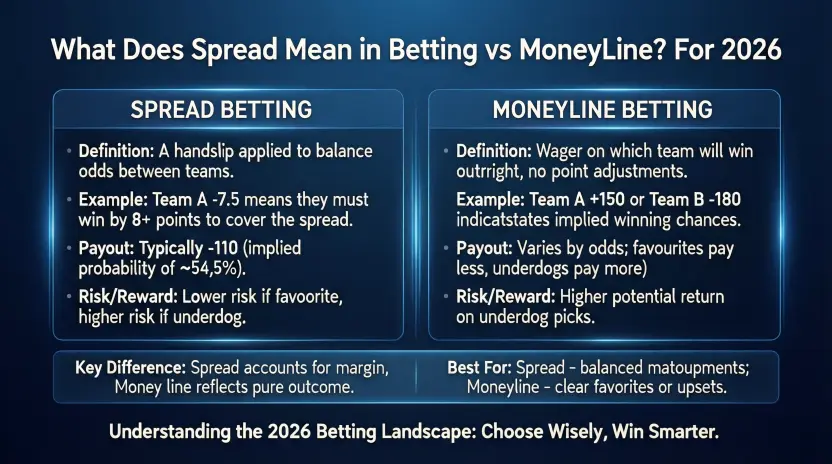
Spread Betting vs Moneyline Betting
When exploring sports betting, it’s important to understand how spread betting differs from moneyline betting, as each offers a unique approach and strategy. While spread betting focuses on the margin of victory, moneyline betting is much simpler: it’s all about picking the winner of the game, regardless of the score.
In spread betting, a team must cover the spread for a bet to win. For example, if a football team is -7, they need to win by more than seven points. If they win by fewer points or lose, the bet fails. Spread betting is designed to level the playing field between favorites and underdogs, which is why odds for both sides are often set at -110, meaning you risk $110 to win $100.
Moneyline betting, on the other hand, eliminates point spreads entirely. You simply choose which team you believe will win the game. Favorites have lower payouts, while underdogs have higher payouts to reflect their lower chances of winning. For example, betting $100 on a favorite might only win you $50, whereas a $100 bet on an underdog could win $200.
The main advantage of spread betting is that it provides opportunities even when betting on the underdog; a strong team might win the game but fail to cover, giving underdog bettors a chance to profit. Moneyline betting is easier for beginners because you don’t need to worry about point spreads, but payouts can be limited if you consistently bet on favorites.
In summary, spread betting adds complexity and strategy, while moneyline betting is simpler and straightforward. Choosing between them depends on your risk tolerance and betting goals.
Spread Betting vs Over/Under (Totals)
Another popular form of sports betting is over/under betting, also known as totals betting, and it works differently from spread betting. While spread betting focuses on the margin of victory, over/under bets are concerned with the combined total points scored by both teams in a game.
In an over/under bet, the sportsbook sets a number, such as 48.5 points for a football game. Bettors then choose whether the actual combined score will be over or under that number. For example, if the final score is 28–24 (total 52 points) and you bet on the over, you win. If the total is 42 points and you bet under, you win. Unlike spread betting, the winner of the game doesn’t matter; only the total score counts.
Over/under betting is often seen as easier for beginners because it removes the need to evaluate favorites versus underdogs or point spreads. Instead, the focus is on factors like team offense and defense, pace of play, and scoring trends. However, totals can be tricky if games are unpredictable or if weather and injuries affect scoring.
Comparing the two, spread betting can offer more strategic opportunities, particularly if you understand how teams perform against the spread (ATS). Over/under bets are simpler but require careful analysis of scoring tendencies rather than win-loss predictions.
In short, while spread betting tests your prediction of the margin, over/under betting tests your ability to forecast total points. Both are popular and can complement each other in a bettor’s strategy, depending on whether you prefer focusing on who wins or how much scoring occurs.
Spread Betting Odds & Payouts
In spread betting, understanding odds and payouts is essential because they determine how much you can win or lose. Most spread bets are offered at -110 odds, meaning you must risk $110 to win $100. This fee, called the vig or juice, is how sportsbooks earn money regardless of which side wins. The odds are usually the same for both the favorite and the underdog, making the spread more about predicting performance than finding better payouts.
For example, if you bet $110 on a team to cover a -6.5 spread and they succeed, you win $100 plus your original $110 stake. If your bet loses, you forfeit the $110. This standardization simplifies calculations for beginners while ensuring sportsbooks profit from every game.
Occasionally, spreads may have different odds to attract more bets on one side or account for public betting trends. For instance, a team might have -120 odds instead of -110, meaning you must risk $120 to win $100. Understanding these variations is important because even small changes can affect your expected returns over multiple bets.
Payouts are only affected by whether your team covers the spread, not by the actual margin beyond the spread. Winning by one point more than required yields the same payout as exceeding it by 20 points.
In short, spread betting combines predictive skill with standardized odds. Knowing the typical -110 format, recognizing variations, and understanding how payouts work allows bettors to calculate potential profits and manage their bankroll effectively, making spread betting both strategic and consistent.
Line Movement in Spread Betting
In spread betting, line movement refers to the way sportsbooks adjust the point spread over time leading up to a game. Spreads are not fixed; they can change based on factors such as betting patterns, injuries, weather conditions, or public perception. Understanding line movement is critical for bettors who want to find value and make informed decisions.
When a large amount of money is placed on one side, sportsbooks may move the spread to encourage bets on the other team. For example, if most bettors are wagering on the favorite -6.5, the sportsbook might adjust the line to -7 or -7.5 to make betting on the underdog more attractive. This helps the sportsbook balance action and reduce potential losses.
Line movement can also reflect insider or “sharp” money. Experienced bettors often place large bets early, signaling confidence in one side. If the line moves after these bets, it can indicate where informed bettors are placing their money, giving others insight into potential outcomes.
External factors like injuries, suspensions, or weather can also cause spreads to shift. For instance, if a star quarterback is injured before a game, the favorite’s spread might decrease because their chances of winning by a large margin drop.
For bettors, understanding line movement means knowing when to place a bet. Betting early might lock in a favorable spread, while waiting could provide better insight but less value. Tracking how spreads move over time allows bettors to spot trends, assess risk, and make smarter, strategic bets. In essence, line movement turns spread betting into a dynamic, real-time game of prediction.
Is Spread Betting Risky?
Spread betting can be exciting and potentially profitable, but it carries inherent risks that every bettor should understand. Unlike simple win-loss bets, spread betting requires predicting not only who will win but also by how much. This added layer of complexity increases the difficulty and potential for losses, especially for beginners.
One major risk is that favorites don’t always cover the spread, even if they win the game. A team might win comfortably but fail to exceed the point spread, resulting in a lost bet. Conversely, underdogs can lose the game but still cover the spread, which may confuse inexperienced bettors.
Another risk is line movement. Spreads can change before the game based on betting patterns, injuries, or other external factors. A bettor who places a wager too late may face a less favorable spread, reducing potential profits or increasing the risk of loss.
Bankroll management is also crucial. Betting large amounts on a single spread bet can lead to significant losses if the outcome doesn’t go as predicted. Spread betting requires discipline, patience, and a clear understanding of probabilities and statistics.
However, with research and strategy, risk can be managed. Bettors who study team performance, trends, and ATS (against the spread) records can make more informed decisions. Spread betting rewards skillful analysis but punishes hasty or emotional choices.
In summary, spread betting is riskier than simple moneyline bets because it adds a margin-of-victory requirement. While it offers opportunities for profit and strategic play, bettors should approach it carefully and never risk more than they can afford to lose.
Spread Betting Strategies for Beginners
For beginners, spread betting may seem intimidating at first, but following a few simple strategies can help improve your chances of success. Unlike moneyline bets, spread betting requires careful evaluation of both the teams and the point spread, rather than just picking who will win.
The first strategy is researching teams and matchups. Look at recent performance, injuries, player form, and home-field advantage. Teams often perform differently on the road versus at home, and injuries to key players can significantly affect their ability to cover the spread. Understanding these details gives you an edge over casual bettors.
Another strategy is tracking against-the-spread (ATS) records. Some teams may have average win-loss records but perform consistently well against the spread. Analyzing historical ATS data helps you identify value bets rather than betting solely on favorites or underdogs.
Line shopping is also important. Different sportsbooks may offer slightly different spreads or odds for the same game. By comparing lines, you can find better value and increase your potential profit.
Managing risk is another key strategy. Avoid betting more than a small percentage of your bankroll on a single spread bet. Emotional betting, such as chasing losses, often leads to mistakes. Stick to a disciplined approach, focusing on analysis and value rather than impulse.
Finally, start with small bets to gain experience. Over time, tracking outcomes and analyzing results will help you understand trends and develop your own spread betting strategy. With research, discipline, and patience, beginners can gradually become more confident in placing spread bets.
Bankroll Management for Spread Betting
One of the most important aspects of spread betting is managing your bankroll effectively. Even experienced bettors can face significant losses if they do not carefully plan how much money to risk on each bet. Bankroll management helps ensure that losses do not wipe out your account and allows for long-term betting success.
A common strategy is flat betting, where you wager the same amount on every bet, usually 1–5% of your total bankroll. For example, if your bankroll is $1,000, you might risk $20 per bet (2%). This approach minimizes the impact of losses while allowing steady growth over time. Avoid betting large percentages of your bankroll on a single spread bet, as the risk of losing a substantial portion of your money is too high.
Another important principle is avoiding emotional betting. Betting on a favorite just because you like the team or trying to chase losses can quickly deplete your bankroll. Successful bettors make decisions based on research, statistics, and trends, not feelings.
Record keeping is also crucial. Track your bets, including spreads, outcomes, and reasoning. Reviewing past performance helps identify what strategies work and where mistakes occur.
Finally, be patient and realistic. Spread betting is a long-term game, and even well-researched bets can lose due to unpredictable events. By managing your bankroll wisely, you can survive losing streaks, capitalize on opportunities, and steadily grow your betting experience and potential profits.
In short, bankroll management is the foundation of responsible and successful spread betting. It reduces risk, encourages discipline, and allows bettors to make informed decisions without the pressure of overexposure.
Common Spread Betting Mistakes to Avoid
Spread betting can be exciting, but beginners often make mistakes that lead to unnecessary losses. Understanding these pitfalls can help you become a smarter, more disciplined bettor.
One common mistake is betting favorites blindly. Just because a team is expected to win doesn’t mean it will cover the spread. Favorites often carry large point spreads, making it more difficult to win consistently. It’s important to evaluate whether the favorite can realistically exceed the spread rather than assuming a win guarantees a successful bet.
Another frequent error is ignoring injuries or key player news. A star player missing a game can drastically affect a team’s ability to cover the spread. Staying updated on team news, lineup changes, and other factors is essential before placing a bet.
Many beginners also overvalue recent results. A team on a winning streak may seem like a safe bet, but spread betting requires evaluating the matchup, not just momentum. Historical performance against the spread (ATS) is often more reliable than recent wins or losses.
Not shopping for the best lines is another mistake. Different sportsbooks may offer slightly different spreads or odds. Choosing the best line can improve your potential returns and provide better value for your bets.
Finally, chasing losses or betting emotionally is a major risk. Making impulsive bets to recover money often leads to bigger losses. Successful spread bettors rely on research, strategy, and discipline.
In short, avoiding these common mistakes blindly betting favorites, ignoring injuries, overvaluing streaks, not comparing lines, and betting emotionally can help beginners approach spread betting more strategically and increase their chances of long-term success.
Spread Betting in Different Sports
Spread betting is popular across many sports, but it works slightly differently depending on the game. Understanding how spreads are applied in each sport can help bettors make more informed decisions and identify opportunities for profit.
In football, spreads are among the most common forms of betting. Point spreads typically range from 1 to 10 points, depending on team strength and matchup. Football is lower scoring than basketball, so each point carries more weight, making precise predictions crucial. Bettors often rely on statistics like yards gained, turnovers, and team trends to evaluate whether a team can cover the spread.
In basketball, spreads tend to be larger because games are high scoring. A favorite might have a -8 or -10 spread. The high scoring nature of basketball allows for greater fluctuations in margin, so bettors often analyze pace, shooting percentages, and recent performance streaks. Covering the spread in basketball can be easier or harder depending on whether the team maintains consistent scoring.
College sports, such as football and basketball, also have spreads, but they can be more unpredictable. Differences in team quality, coaching, and experience often lead to unexpected outcomes. Beginners need to account for this variability when betting on college games.
Other sports like baseball, hockey, and soccer sometimes use spread betting in unique ways. For instance, baseball spreads are often run lines (e.g., -1.5, +1.5) rather than traditional point spreads. Understanding the rules and scoring system of each sport is essential.
In summary, spreads exist in almost every major sport but vary in size and complexity. Knowledge of the sport, scoring trends, and team performance is key to making informed spread bets.
Is Spread Betting Legal?
Before placing any spread bets, it’s important to understand the legal status of sports betting, as it varies by country, state, and even region. Legal considerations affect where and how you can place bets safely and responsibly.
In the United States, sports betting is legal in some states but not others. Since the Supreme Court struck down the federal ban on sports betting in 2018, individual states have been able to regulate betting within their borders. States like New Jersey, Nevada, and Pennsylvania have fully legalized sportsbooks, both online and in-person. Other states may allow limited forms of betting or none at all. It’s important to check local laws before placing a spread bet.
In other countries, legality also differs. For example, sports betting is widely regulated and legal in the United Kingdom, Australia, and Canada, but in some regions, it is heavily restricted or illegal. Online sportsbooks may accept bets from international users, but this does not always guarantee legal protection.
Even in legal markets, bettors must use licensed and regulated sportsbooks. Licensed sportsbooks are required to follow strict rules to ensure fair play, secure transactions, and responsible gambling measures. Betting with unlicensed sites can result in losing funds or facing legal issues.
Finally, responsible gambling is essential. Even in legal jurisdictions, bettors should only risk money they can afford to lose and follow limits to avoid problem gambling.
In short, spread betting is legal in many areas but not everywhere. Knowing your jurisdiction’s laws, using licensed sportsbooks, and betting responsibly are essential steps for a safe and enjoyable betting experience.
Common Spread Betting Terms You Should Know
Spread betting comes with its own set of terminology, and understanding these terms is essential for anyone looking to place informed bets. Knowing the language helps you interpret spreads correctly and follow betting strategies more effectively.
One of the most common terms is ATS (Against the Spread). This refers to a team’s performance relative to the point spread. For example, a team with a strong ATS record may consistently cover spreads, even if their overall win-loss record is average. Bettors often study ATS data to find trends and identify value bets.
The term cover simply means a team has met or exceeded the spread. For the favorite, covering requires winning by more than the spread. For the underdog, it means either winning outright or losing by fewer points than the spread.
Another important term is the vig or juice, which is the commission sportsbooks take on bets. Typically, this is built into standard odds like -110, meaning you risk $110 to win $100. Understanding the vig is crucial for calculating potential profits and losses.
Line movement refers to changes in the point spread leading up to a game, often caused by betting patterns, injuries, or public perception. Paying attention to line movement can help bettors identify valuable opportunities.
Other terms include push (when the game exactly matches the spread), key numbers (common margins in sports like 3 or 7 in football), and run lines (used in sports like baseball instead of traditional spreads).
In short, mastering spread betting terminology ATS, cover, vig, line movement, and push is essential for making informed decisions. Familiarity with these terms allows beginners to navigate betting markets with confidence and strategy.
FAQs About Spread Betting
Beginners often have many questions about spread betting, and understanding these common concerns can help you bet more confidently.
What does +7.5 mean in betting?
A +7.5 spread means the team is an underdog and can either win outright or lose by fewer than 7.5 points to cover the spread. The half-point eliminates the possibility of a push, ensuring there is a clear winner for the bet.
Can you lose a spread bet even if your team wins?
Yes. If your team is the favorite, it must win by more than the spread to cover. For example, if a team is -7 and wins by 6 points, the bet on them loses. Spread betting focuses on the margin of victory, not just winning the game.
Is spread betting better than moneyline betting?
It depends on your strategy. Spread betting allows both favorites and underdogs to be profitable, adding more betting opportunities. Moneyline betting is simpler because you only pick the winner, but payouts for favorites are usually smaller.
Is spread betting good for beginners?
Yes, with research and discipline. Understanding point spreads, line movement, and ATS records is crucial. Beginners should start with small bets, track results, and avoid emotional decisions.
Why are most spreads set at -110?
-110 odds include the vig, or commission, that ensures sportsbooks make money regardless of the outcome. Bettors risk $110 to win $100.
By answering these FAQs, beginners can quickly grasp the fundamentals of spread betting, manage risk, and develop a strategic approach to betting on point spreads. Spread betting may seem complex at first, but with practice and knowledge, it becomes a manageable and strategic form of wagering.
Conclusion
Spread betting is one of the most popular and strategic forms of sports wagering, offering opportunities beyond simply picking a winner.
Unlike moneyline bets, spread betting requires predicting how much a team will win or lose by, which adds a layer of skill and strategy to every wager. Understanding concepts like favorites and underdogs, point spreads, covering the spread, pushes, and line movement is essential for making informed bets.
For beginners, spread betting may seem intimidating at first, but breaking it down into clear steps reading the spread, analyzing matchups, tracking against-the-spread (ATS) records, and managing your bankroll makes it approachable.
Using proper strategies, avoiding common mistakes, and understanding the terminology can significantly improve your chances of success.
Bankroll management, research, and discipline are key. Betting emotionally or without analyzing team performance can quickly lead to losses, while consistent, informed decisions help you maximize value and minimize risk.
Spread betting is not just about luck; it rewards those who take the time to study teams, understand odds, and track trends.
Finally, legal and responsible betting is crucial. Always use licensed sportsbooks in jurisdictions where sports betting is allowed and never risk more than you can afford to lose.
In summary, spread betting transforms the question from “Who will win?” to “By how much will they win or lose?” With patience, practice, and strategy, beginners can confidently navigate point spreads, make smart wagers, and enjoy a more engaging betting experience.
Spread betting is challenging, but mastering it can make watching sports more exciting and potentially profitable.

Punny Parker — Serving witty wordplay, clever jokes, and daily pun-filled fun. Whether it’s smart humor or pure silliness, every post brings a smile, a laugh, or a groan-worthy pun you’ll secretly love. Powered by ThePunSide.com for endless laughs and wordplay magic every day.