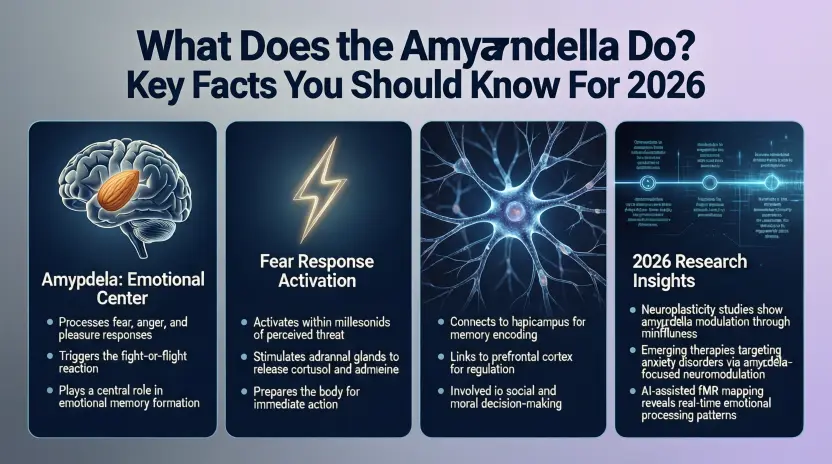
The amygdala, a small almond-shaped structure deep within the brain, might be tiny, but it wields incredible influence over how we feel, react, and remember.
Often called the brain’s emotional center, the amygdala plays a critical role in processing emotions like fear, anger, and joy, and it helps determine how we respond to stress or potential threats.
Beyond emotions, it also interacts closely with other parts of the brain, such as the hippocampus and prefrontal cortex, influencing memory formation, decision-making, and even social behavior.
Understanding what the amygdala does is essential not just for neuroscience enthusiasts but for anyone looking to improve mental health, manage stress, or gain insight into human behavior.
In this article, we’ll explore the functions of the amygdala, its role in emotional and cognitive processes, how it affects everyday life, and practical ways to regulate its activity for emotional well-being.
Anatomy of the Amygdala
The amygdala is a small, almond-shaped cluster of nuclei located deep within the temporal lobe of the brain. Despite its relatively tiny size roughly the size of an almond it plays a massive role in regulating emotions, memory, and behavior. Each hemisphere of the brain contains one amygdala, meaning we have a pair that works together to process emotional information.
Structurally, the amygdala is divided into several key regions, each with its own specialized functions. The basolateral complex is involved in attaching emotional significance to experiences and forming emotional memories. The central nucleus helps generate physiological responses to fear and stress, coordinating signals with the hypothalamus to trigger the fight-or-flight response. Other regions, like the corticomedial nuclei, are important for social behavior and olfactory processing in humans and animals.
The amygdala is also highly interconnected with other brain regions. Its connections to the hippocampus allow it to link emotions with memories, while links to the prefrontal cortex help regulate emotional responses and decision-making. This network explains why the amygdala can influence not just how we feel but also how we act, react, and remember.
Understanding the amygdala’s anatomy provides a foundation for exploring its many functions, from emotional processing to stress response. Despite being small, its complexity underlines why it is considered the emotional command center of the brain.
Core Functions of the Amygdala
The amygdala is often called the brain’s emotional hub because it plays a central role in processing and responding to emotions. One of its most well-known functions is emotional processing. It evaluates incoming sensory information and determines its emotional significance, helping us react appropriately to different situations. For example, the sight of a dangerous animal can trigger an immediate fear response, thanks to the amygdala.
Another key role is fear and threat detection. The amygdala acts as an alarm system, identifying potential dangers and initiating the fight-or-flight response by signaling the hypothalamus and other brain regions. This rapid reaction is essential for survival, allowing humans and animals to respond quickly to threats.
The amygdala also contributes to emotional memory formation. It works closely with the hippocampus to attach emotional significance to memories, which is why emotionally charged events are often remembered more vividly than neutral ones.
Beyond fear, the amygdala influences social behavior and decision-making. It helps interpret facial expressions, detect trustworthiness, and guide responses in social interactions. Its activity affects empathy, motivation, and even moral judgments.
In summary, the amygdala’s core functions revolve around understanding, reacting to, and remembering emotional experiences. By regulating emotions, fear responses, and social interactions, it plays a vital role in shaping behavior and maintaining psychological well-being.
The Amygdala and Stress Response
The amygdala plays a critical role in how the body perceives and responds to stress. When the brain detects a potential threat whether physical danger or a stressful situation the amygdala quickly sends signals to the hypothalamus, which activates the fight-or-flight response. This process releases stress hormones like adrenaline and cortisol, preparing the body to react instantly. Heart rate increases, breathing becomes rapid, and muscles tense, all thanks to the amygdala’s rapid response system.
While this mechanism is essential for survival, chronic stress can over-activate the amygdala, leading to heightened anxiety, irritability, and even difficulty regulating emotions. Studies have shown that prolonged stress can enlarge certain amygdala regions, which may increase fear responses and emotional sensitivity over time.
The amygdala also interacts with the prefrontal cortex, the brain’s center for reasoning and decision-making. When the prefrontal cortex is underactive or overwhelmed, the amygdala can dominate emotional responses, causing impulsive reactions or anxiety-driven behavior. This explains why stress often makes it harder to think clearly or make rational decisions.
Interestingly, research suggests that activities like mindfulness, meditation, and exercise can help regulate amygdala activity. By strengthening prefrontal control over the amygdala, people can reduce emotional reactivity and improve resilience to stress.
Understanding the amygdala’s role in stress highlights why managing emotions and stress isn’t just psychological, it’s deeply biological, rooted in the brain’s emotional center.
Amygdala in Learning and Memory
The amygdala is not just about emotions it also plays a vital role in learning and memory. One of its key functions is emotional memory formation, which allows the brain to attach feelings to experiences. For instance, a joyful event, like receiving praise, or a frightening experience, like narrowly avoiding an accident, becomes more memorable because the amygdala signals the hippocampus to strengthen the memory. This connection explains why emotionally charged memories often feel more vivid and last longer than neutral ones.
The amygdala also influences associative learning, where the brain links a stimulus with a response. A classic example is Pavlovian conditioning: if a sound or cue is repeatedly paired with a positive or negative outcome, the amygdala helps the brain remember the emotional significance of that cue. This mechanism is essential for adapting behavior based on past experiences.
Moreover, the amygdala works closely with the prefrontal cortex to guide decision-making based on prior experiences. By evaluating emotional outcomes, it helps individuals choose actions that maximize rewards and minimize risks. This interaction is critical not only in learning from mistakes but also in forming social and moral judgments.
In short, the amygdala ensures that our learning is not purely cognitive but emotionally informed. Its integration with memory systems allows humans to remember, react, and adapt effectively, highlighting its importance in both daily life and long-term personal development.
The Amygdala in Daily Life
The amygdala is constantly at work, shaping our daily experiences in ways we often don’t notice. From quick emotional reactions to long-term behavioral patterns, this small brain structure influences how we perceive and respond to the world around us. For example, when you feel sudden anxiety before a presentation or excitement when meeting a friend, the amygdala is at the center of those emotional responses.
It also plays a key role in decision-making. By assessing emotional cues from the environment, the amygdala helps guide choices, often prioritizing safety or rewards. This is why gut feelings or instinctive reactions are so closely tied to emotions it’s your amygdala signaling what matters most.
Social interactions are another area where the amygdala is critical. It helps us interpret facial expressions, detect social cues, and evaluate trustworthiness, which influences relationships and social behavior. People with atypical amygdala function may struggle with understanding emotions in others, highlighting its importance in empathy and communication.
Furthermore, the amygdala impacts habit formation and risk assessment. Emotional experiences associated with actions or outcomes can reinforce certain behaviors, either encouraging repetition or avoidance. For instance, a positive emotional reward can strengthen habits, while fear or stress can create avoidance patterns.
In short, the amygdala quietly orchestrates much of our emotional life, guiding decisions, social interactions, and behaviors. Recognizing its role helps us understand why we react the way we do and opens the door to better emotional regulation.
Disorders Linked to Amygdala Dysfunction
The amygdala’s critical role in emotional processing and stress response means that when it malfunctions, it can contribute to a variety of mental health disorders. One of the most common is anxiety disorders. Overactive amygdala activity can heighten fear responses, making everyday situations feel threatening and triggering excessive worry or panic attacks.
Post-Traumatic Stress Disorder (PTSD) is closely tied to amygdala function. In PTSD, the amygdala often becomes hyperactive, causing strong, intrusive emotional memories related to trauma. This heightened reactivity can lead to exaggerated fear responses, hypervigilance, and difficulty regulating emotions.
Depression is another condition linked to amygdala dysregulation. Studies have found that individuals with depression may have altered amygdala activity, affecting how they process negative emotions and memories. This can contribute to persistent sadness, irritability, or emotional numbness.
The amygdala is also involved in phobias, where specific stimuli trigger intense, irrational fear due to abnormal amygdala responses. In some cases, it can influence autism spectrum disorders, affecting social behavior and the ability to interpret emotions in others.
Understanding these connections highlights the amygdala’s importance in mental health. Treatments such as cognitive-behavioral therapy, mindfulness, and certain medications aim to regulate amygdala activity, helping individuals manage fear, stress, and emotional imbalance. By targeting the amygdala’s function, researchers and clinicians can improve both emotional well-being and quality of life.
Can You Train or Calm Your Amygdala?
The good news is that the amygdala is not a fixed system; it can be regulated and “trained” through various practices that enhance emotional balance. One of the most effective methods is mindfulness and meditation. Regular mindfulness exercises help strengthen the connection between the prefrontal cortex and the amygdala, allowing better control over emotional reactions. This reduces impulsive fear responses and promotes calm decision-making.
Cognitive-behavioral techniques (CBT) are another powerful tool. By identifying negative thought patterns and reframing them, individuals can reduce amygdala hyperactivity triggered by stress or anxiety. Over time, this practice helps the brain respond more rationally to situations that previously triggered strong emotional reactions.
Physical activity also plays a significant role. Regular exercise lowers stress hormones like cortisol, improves mood, and can even reduce the amygdala’s responsiveness to perceived threats. Activities like yoga, deep-breathing exercises, and progressive muscle relaxation have similar calming effects.
Sleep is another factor that impacts amygdala regulation. Lack of sleep can increase emotional reactivity, whereas quality rest allows the brain to process emotions more effectively.
Finally, practicing emotional awareness by noticing feelings without judgment helps individuals understand triggers and reduce the amygdala’s overreaction. By combining mindfulness, therapy, exercise, and proper rest, people can effectively calm their amygdala, improve emotional regulation, and build resilience to stress.
Fun Facts About the Amygdala
The amygdala may be small, but it has some fascinating and surprising features that make it one of the most intriguing parts of the brain. For starters, its name comes from the Greek word “amygdale,” meaning almond, because of its shape. Despite its size roughly 1–2 centimeters in humans it has an outsized influence on emotions, memory, and behavior.
One fun fact is that the amygdala is highly active even in animals, highlighting its evolutionary importance. From rodents to primates, it helps detect danger, assess threats, and respond to social signals. This evolutionary consistency shows why humans still rely on the amygdala for instinctive reactions.
Interestingly, the amygdala responds more strongly to negative emotions than positive ones. This is why fear, anger, or sadness often feel more intense and memorable compared to neutral or happy experiences. Evolutionarily, this heightened response helped humans survive threats.
Another fun feature is the amygdala’s role in recognizing facial expressions. It helps us detect emotions like fear, happiness, or anger in others, which is crucial for social interaction and communication. People with amygdala damage may struggle to read emotions in others, which can impact relationships.
Finally, research shows that the amygdala can physically change with experience. Stress, trauma, or mindfulness practices can alter its size and connectivity, demonstrating its incredible plasticity.
These facts highlight how the amygdala is not just a scientific concept, it’s a living, adaptable part of our emotional life, shaping how we feel, react, and interact every day.
Conclusion
The amygdala, though small in size, plays a massive role in shaping our emotions, memories, and behavior.
Often referred to as the brain’s emotional command center, it allows us to react to danger, form emotional memories, and navigate social interactions.
From triggering fear in response to a perceived threat to helping us remember life-changing events, the amygdala’s influence is profound and constant.
Its connections with the hippocampus, prefrontal cortex, and other brain regions make it essential not only for emotional processing but also for decision-making, learning, and stress management.
When the amygdala is overactive, it can contribute to disorders like anxiety, PTSD, depression, and phobias, highlighting the importance of understanding its function for mental health.
The good news is that we are not powerless over our amygdala. Mindfulness, meditation, cognitive-behavioral strategies, exercise, and quality sleep can all help regulate its activity, allowing us to respond to emotions more calmly and thoughtfully.
By learning about the amygdala, we gain insight into why we react the way we do, why certain memories stick, and how to build emotional resilience.
Ultimately, the amygdala reminds us that emotions are deeply biological, yet adaptable.
By respecting and managing this small but mighty brain structure, we can improve our emotional intelligence, enhance mental well-being, and lead a more balanced, mindful life.
Understanding what the amygdala does is a step toward mastering not just our minds, but our emotional lives.
Frequently Asked Questions About the Amygdala
1. What does the amygdala do in the brain?
The amygdala processes emotions, detects threats, and forms emotional memories. It influences behavior, decision-making, and social interactions, making it essential for emotional intelligence and survival.
2. Where is the amygdala located?
The amygdala is a small, almond-shaped cluster of nuclei located deep within the temporal lobe, with one in each hemisphere of the brain.
3. How does the amygdala affect fear and anxiety?
The amygdala acts as the brain’s alarm system, triggering fear responses and activating the fight-or-flight mechanism. Overactivity can lead to anxiety disorders, phobias, or PTSD.
4. Can you control your amygdala?
Yes. Practices like mindfulness, meditation, cognitive-behavioral therapy, regular exercise, and quality sleep can regulate amygdala activity, helping reduce stress and emotional overreactions.
5. What is the amygdala’s role in memory?
It attaches emotional significance to memories by interacting with the hippocampus. Emotional memories, whether positive or negative, are stored more vividly and recalled more easily.
6. Can amygdala dysfunction affect social behavior?
Yes. The amygdala helps interpret facial expressions and social cues.
Dysfunction may impair empathy, social judgment, and the ability to respond appropriately in social situations.
7. Is the amygdala involved in depression?
Research shows altered amygdala activity in people with depression, affecting emotional processing and the response to negative stimuli.
This makes emotional regulation strategies crucial for mental well-being.

Owen Carter — Creating moments that inspire, entertain, and connect. From creative ideas to daily insights, this page brings personality, passion, and authenticity in every post. Powered by ThePunSide.com for even more creativity, humor, and good vibes every day.